Full text
The first dinosaur found in Antarctica belonged to a group that included the largest animals ever to walk the planet, a new study finds.
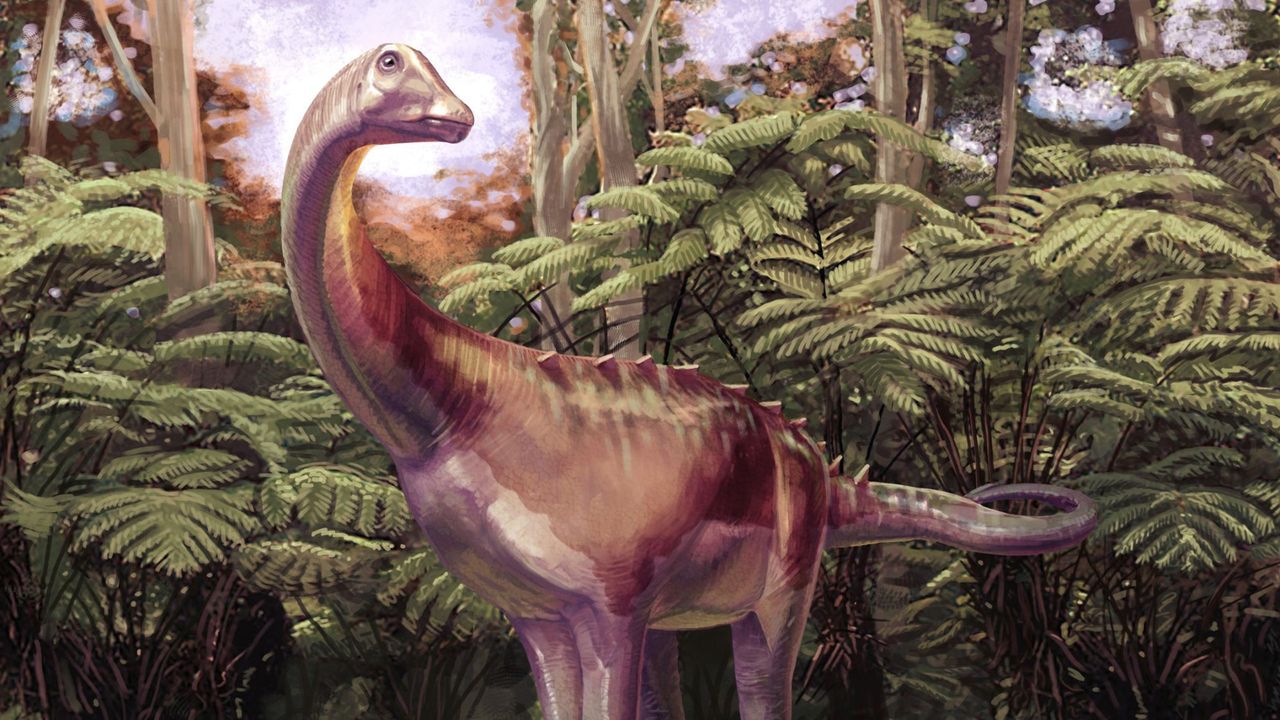
A backbone from the 82 million-year-old giant was discovered more than 40 years ago, but at the time, researchers assumed it came from an ancient marine reptile. Now a new study, published June 29 in the journal Acta Palaeontologica Polonica , has revealed that it was actually a titanosaur — the group of long-necked sauropods that included the largest land animals on record.
"At first glance this appears to be an unremarkable fossil, but it holds an important place in the history of Antarctic exploration as the first dinosaur fossil found on the continent," study first author Paul Barrett , a paleontologist at the Natural History Museum in London, said in a statement .
While this fossil now holds the record for the first dinosaur fossil found in Antarctica, other dinosaur fossils were identified on the continent after its discovery, so it's not the only known Antarctic dinosaur. In fact, researchers have identified a variety of dinosaurs on Antarctica, with another sauropod fossil identified as a titanosaur in 2011.
The newly identified dinosaur was around 20 to 23 feet (6 to 7 meters) long. That's very small compared with the largest-known titanosaurs, which could grow up to 123 feet (37.5 m) long. However, as the fossil is just a fragment of a vertebra, researchers are unable to narrow down which species the Antarctic titanosaur belonged to, and it's possible that the individual was only a juvenile when it died.
Mike Thomson, a British Antarctic Survey geologist, found the fossil during an expedition to James Ross Island in 1985. The island, which has been the site of multiple dinosaur discoveries, is located off the northeastern Antarctic Peninsula, south of the 600-mile-wide (965 kilometers) Drake Passage that separates South America from Antarctica.
Antarctica is well known for its icy landscapes, but when titanosaurs roamed Earth, the continent was still attached to South America and full of temperate forests. Antarctica's dinosaurs were so far south that they would have lived in constant twilight during the winter months, according to a news article published by the Natural History Museum.
The authors of the new study identified the dinosaur using high-resolution CT scans, which enabled them to look inside the fossil. Dating back to the Cretaceous period (143 million to 66 million years ago), the titanosaur lived in the last age of the non-avian dinosaurs, before an enormous asteroid hit what is now Mexico's Yucatan Peninsula 66 million years ago and wiped them out.
RELATED STORIES
'Last titan' of Thailand discovered, and it's the longest-necked dinosaur on record from Southeast Asia
Giant 'cow of the Cretaceous' discovered almost 100 years ago identified as new duck-billed dinosaur
'He began to cry, and almost fell to the floor': The fluffy fossil that finally showed the world that birds are dinosaurs
The Antarctic titanosaur helps researchers better understand how dinosaurs spread across Earth's southern continents, which at the time were combined into a supercontinent called Gondwana. The presence of titanosaurs on Antarctica suggests that they may have used Antarctica to travel from what is now South America to New Zealand.
Other dinosaurs identified on Antarctica include small herbivores, armored ankylosaurs and bipedal predators like Imperobator , which would have shared the forests with the newly identified titanosaur. While researchers are beginning to piece together Antarctica's ancient ecosystems, they still have a lot to learn about the dinosaurs that lived there.
"There are likely many more dinosaurs to be discovered on the continent," Barrett said. "As climate change causes ice to retreat we may indeed find further evidence of this past biodiversity."


















Comments
No comments yet — be the first to weigh in 👇
No comments yet. Be the first!