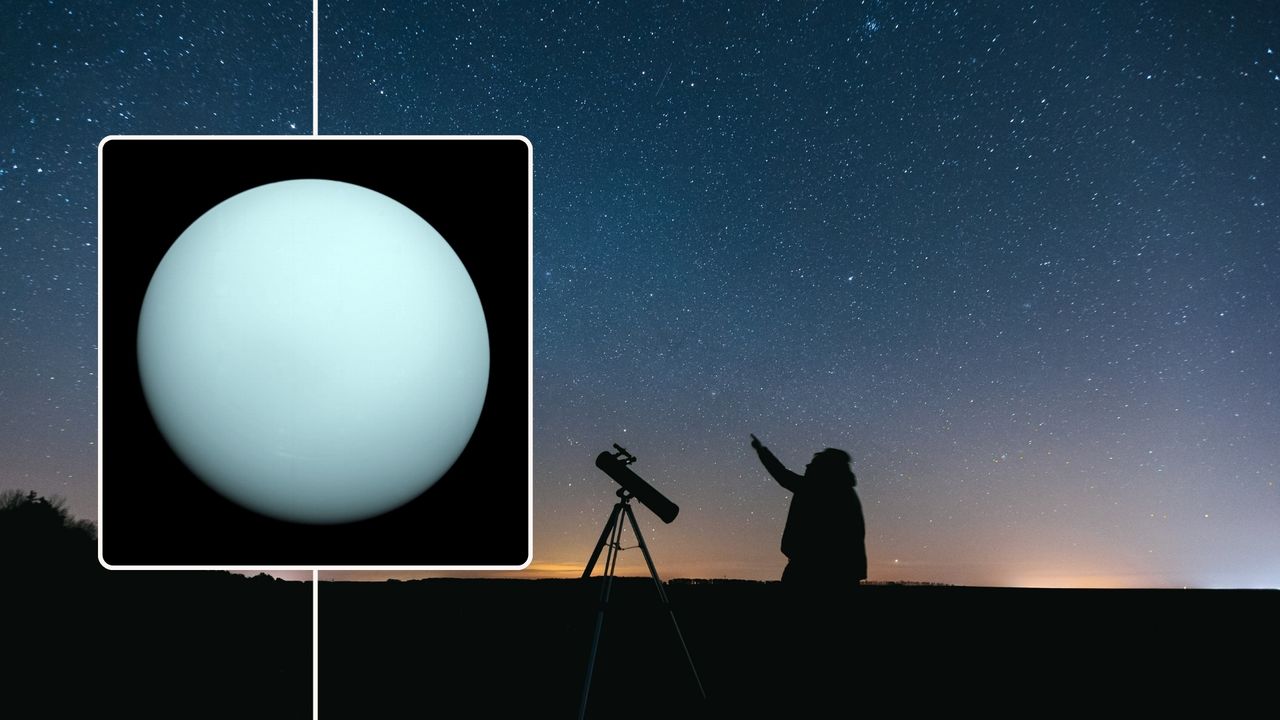
Uranus visible to the naked eye this week — here's how to spot it
Uranus is unusually well-positioned for observation this week, appearing as a blue-green dot roughly 1.8 billion miles (about 2.9 billion kilometres) from Earth. The author first spotted it through a large Dobsonian telescope near Bryce Canyon, Utah, with members of the Salt Lake Astronomical Society. Binoculars or a modest telescope are sufficient to locate it given a dark enough sky this week.
Full text
I used to think Uranus was the sort of planet you graduated into. Saturn and its rings first, obviously. Jupiter and its cloud bands soon after that. Venus, if it's shrinking to a crescent (which it soon will be), and, of course, Mars and its ice caps. But Uranus? The seventh planet feels like something reserved for people with huge telescopes, expensive eyepieces and incredibly lucky atmospheric seeing. It may be considered an ice giant planet, but it's almost four times farther from the sun than Jupiter and twice as far as Saturn — and it's a lot smaller than both. Uranus didn't figure in my plans.
And yet on a frosty evening in September, a few years ago, I finally got to see it as a blue-green dot nearly 1.8 billion miles away. It was through a large Dobsonian telescope belonging to one very generous member of the Salt Lake Astronomical Society, outside the visitor center at Bryce Canyon National Park, which hosts popular astronomy and night-sky programs . Uranus shone dimly, but I could easily make out its color by averting my eyes (looking slightly to the side of the planet rather than directly at it). That way, the human eye's light-sensitive peripheral cells can catch brightness — it's a technique that's worth learning for all kinds of telescopic astronomy. Even then, Uranus looked like a faint, motionless star rather than a glowing planet. It was no Saturn .
What surprised me wasn't finally seeing Uranus — that was down to a massive telescope. It was how suddenly my perception changed once my eye locked onto it. After seeing it up close (ish), I wanted to know exactly where Uranus was in the night sky. Uranus is technically visible to the naked eye, but it is very challenging to see. It shines at 5.7 magnitude — right at the absolute limit of human visibility, but in Bryce Canyon's dark moonless skies, it was definitely there. Was it a satisfying sight? Not especially — but I could not unsee it. That transition — from looking casually to carefully observing, first with powerful optics and then navigating with the naked eye — is what observational astronomy is all about. Uranus now always figures in my plans, but typically only when I have access to a very large telescope.
Finally seeing Uranus is a milestone. Most people remember their first view of Saturn because its rings impress immediately. But many people remember Uranus because they had to work for it. It's a planet you can discover for yourself — and you can do it this week.
What's happening and when to look
Uranus and Mars in conjunction on July 4, 2026. (Image credit: Starry Night) I tend to forget all about Uranus unless it's involved in a conjunction — and that's exactly what's happening. Conjunctions involving Uranus tend to occur a couple of times each year, typically as one of the fast-moving, closer planets — such as Venus and Mars — appear next to it. Venus was close to Uranus back in April, and on July 4, it's the turn of Mars. A conjunction between Mars and Uranus happens about every two years as the red planet surges past on its far quicker journey around the sun (687 Earth days versus the 84 years it takes Uranus).
This won't be the most convenient conjunction to observe, but they'll get to within about 11 arc minutes of each other — extremely close! From the northern hemisphere, the planets will be low on the eastern horizon in the early morning hours before astronomical dawn. The best time to be up and looking east will be about 3:45 a.m. local time. The observing window is only about 45 minutes before dawn, making it harder to find with every passing minute.
How and when I'm watching it
Uranus and Mars will be visible below the Pleiades on July 4, 2026. (Image credit: Starry Night) Find Mars, find Uranus. That's the entire point of using a close conjunction to see the seventh planet. Mars will serve as a guidepost and be easy to see. It will shine at 1.3 magnitude below the sparkling Pleiades open cluster. You won't be able to miss it in a clear sky. All you have to do is look slightly above Mars for Uranus — first with the naked eye, then with any pair of binoculars (I'll be using 10x50 binoculars). The conjunction will be close enough to fit comfortably in binoculars and to look beautiful in a small telescope, if you have one.
Normally, locating Uranus involves hopping through fairly anonymous star fields while constantly second-guessing whether you are looking at a star or the planet itself. Here, Mars does the navigation for you. Your reward will be the sight of a tiny pale point with a subtle blue-green tint. The satisfaction comes less from appearance and more from seeing something so distant directly with your own eyes.
There's also something fitting about this conjunction falling on July 4 during the 250th anniversary year in the U.S. Uranus takes 84 years to orbit the sun , meaning it has completed almost exactly three orbits since the Declaration of Independence was signed in 1776. The planet itself was not discovered until 1781, when William Herschel identified it while searching the sky systematically rather than casually. It's a reminder that back in 1776, only six planets were known about. Now we're on a hunt for a ninth planet (sorry, Pluto ).
Stargazer's corner: July 3-9, 2026
See the moon and Saturn in conjunction early on July 7, 2026. (Image credit: Starry Night) July opens with a slowly darkening sky after the long twilight of late June. Earth reaches aphelion on July 6, its farthest point from the sun (the seasons are driven by Earth's tilted axis, not its distance from the sun). So the sun's disk will be at its smallest in the sky, one factor contributing to the total solar eclipse on Aug. 12 . Meanwhile, the very early hours of July 7 and 8 will see a close conjunction of a last quarter moon and Saturn in the east, kicking off relatively moonless conditions for the following 10 nights or so.
Asterism of the week: Summer Triangle
By early July, the Summer Triangle dominates the sky after dark. Formed by Vega, high overhead, Deneb to the northeast and Altair lower in the south, it creates a vast, unmistakable pattern that defines the season. It's actually not a constellation, but an asterism — a popular shape in the sky, like the Big Dipper — and its scale is what makes it so useful. Once you've got it nailed, it becomes a framework for the entire sky, helping you orient yourself instantly all season long. It also traces the path of the Milky Way , which runs straight through it, adding an extra sight if you're somewhere not blighted by light pollution.
Comments
No comments yet
















Comments
No comments yet — be the first to weigh in 👇
No comments yet. Be the first!