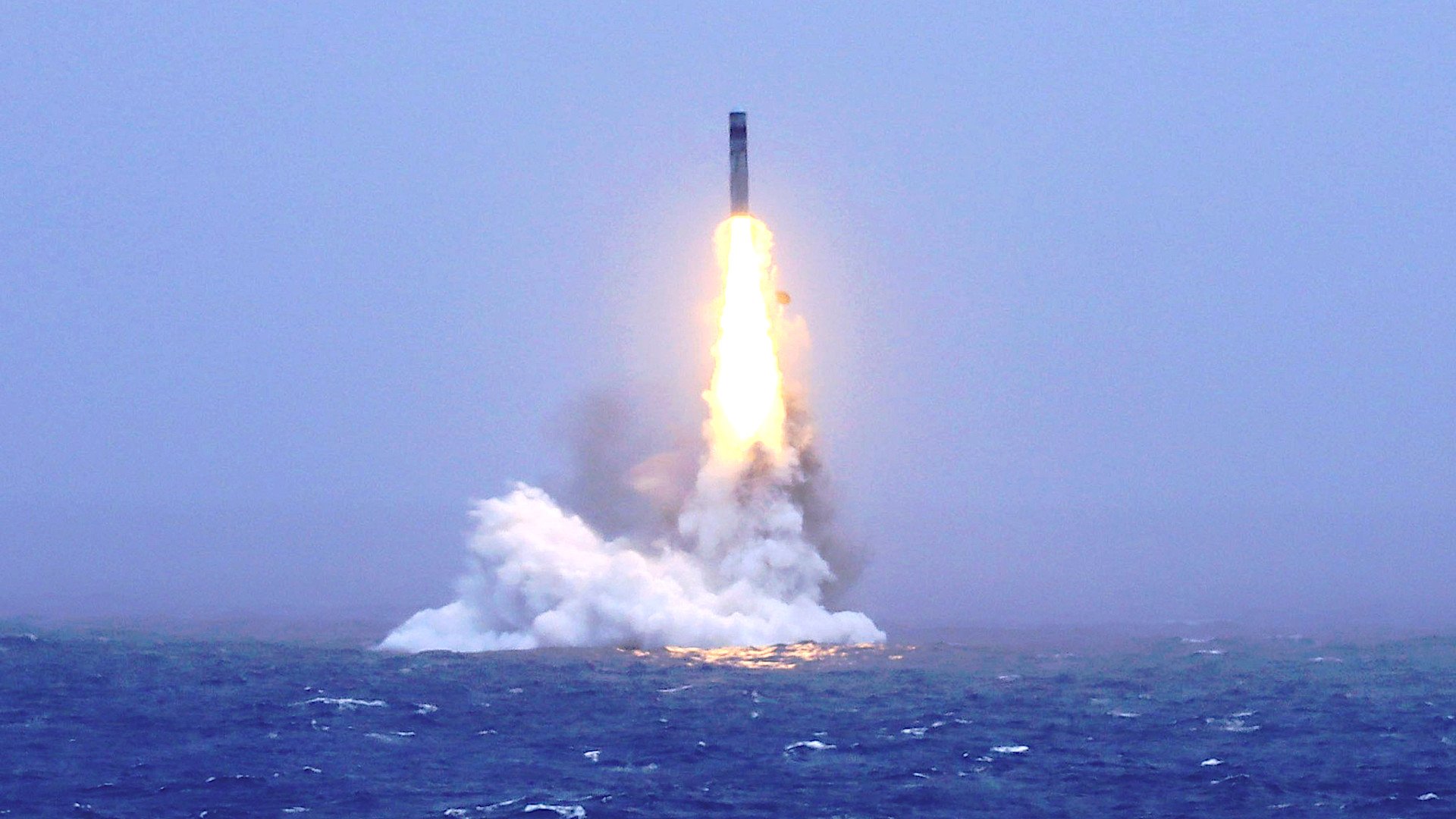
China Fires Submarine-Launched Ballistic Missile Into Pacific in Rare Test
China fired a submarine-launched ballistic missile (SLBM) — either a JL-2 or JL-3 — into the Western Pacific on July 6, in what the PLAN described as a routine annual training exercise with a dummy warhead. The launch is exceptionally rare and marks the first such test in years, if not decades, sending a direct signal to the United States and Indo-Pacific allies. It underscores China's ongoing and accelerating expansion of both its nuclear arsenal and submarine forces.
Full text
China has fired a submarine-launched ballistic missile (SLBM) – either a JL-2 or a JL-3 – out into the Western Pacific for the first time in years, if not decades. The exceptionally rare launch sends immediate signals, especially to the United States and its Indo-Pacific allies. It also underscores China’s major and still-ongoing expansion of its nuclear arsenal , as well as of its submarine forces .
“On July 6, one strategic nuclear submarine of the Chinese People’s Liberation Army Navy [PLAN] successfully launched a submarine-launched strategic missile carrying a training dummy warhead toward the relevant high seas area of the Pacific Ocean, accurately landing in the predetermined sea area,” according to a machine translation of an official PLAN statement . “This missile test launch is a routine arrangement of the Chinese side’s annual military training, and relevant countries have been notified in advance. It complies with international law and international practices and is not directed against any specific country or target.”
An official picture of the Chinese SLBM launch on July 6, 2026. People’s Liberation Army Navy
The PLAN statement does not confirm where the launch was conducted from. Chinese authorities had issued two distinct sets of warning notices ahead of time, suggesting launches from the northern end of the South China Sea and/or the Yellow Sea. The dummy warhead appears to have come down in the Pacific Ocean to the West of the Solomon Islands.
It's possible that China launched up to 2 ballistic missiles into a Pacific target area this morning, one from the South China Sea and one from the Bohai Sea. Or at the least, they were prepared to, based on navigational warnings. pic.twitter.com/modH6cw42D
— Duan Dang (@duandang) July 6, 2026
Japanese authorities were alerted in advance, but have not confirmed whether the missile actually passed over their country. This would still point to a launch from the Yellow Sea. This is further bolstered by the presence in the past week or so of Chinese Yuan Wang class missile tracking ships , at various points roughly along that route, based on publicly available transponder data. The Liaowang-1 intelligence ship , understood to be able to track objects in space, had also been spotted in the region.
Aye. https://t.co/23PARMVD2U pic.twitter.com/m1Mi6sOipj
— Evergreen Intel (@vcdgf555) June 28, 2026
At the same time, Joseph Wu, Secretary-General of the Taiwan National Security Council, wrote in a post on X saying that the missile flew along the route from the South China Sea past the Philippines. At the time of writing, there is no evidence that the PLAN fired two missiles. Both sets of warning notices have now expired.
The #PRC tested a JL2 #SLBM flying over the #Philippines moments ago. It’s a provocation that destabilizes the #IndoPacific . #China just proved itself again to be a bully on the block. pic.twitter.com/dOUbLBclmh
— Joseph Wu (@josephwutw) July 6, 2026
The PLAN statement also does not confirm the type of SLBM or submarine involved in the launch today, but the latter is clear. China’s only nuclear-powered ballistic submarines in service today are its Type 094s, of which it has at least six. There are reports that two more are currently under construction . A new Type 096 nuclear ballistic submarine is understood to be in development, but when it might enter service remains to be seen.
A stock picture of a Chinese Type 094 nuclear ballistic missile submarine. via USN/Congressional Research Service
A post from the China Military Bugle account on X, an official PLA mouthpiece, mentions the JL-2 and the JL-3, and includes stock pictures of both missiles. There are official pictures of the launch, as seen earlier in this story and again below, but it is hard to assess what missile is seen therein. There is limited imagery available publicly of the newer JL-3, and what has been seen suggests it is very similar, at least externally, to its predecessor, as seen below. The JL-3 was only officially shown to the public for the first time at a huge military parade in Beijing last year , marking the 80th anniversary of the country’s victory over Japan in World War II.
The Chinese PLA Navy's test launch of a strategic missile by a submarine was a routine arrangement of China’s annual military training.
It was not targeted at any specific country or target.
China notified relevant countries in advance, which is in line with international… pic.twitter.com/xLZeucqOTm
— China Military Bugle (@ChinaMilBugle) July 6, 2026
The Pentagon has previously assessed the ranges of the JL-2 and JL-3 to be 3,900 and 5,400 nautical miles (approximately 7,200 and 10,000 kilometers), respectively. If today’s launch was at maximum range, this could also point to the missile having been a JL-2, based on the total distances outlined in the warning notices.
SLBM was tested over a stretch of >7300km which suggests a full range of ~ 8000km so most likely it was the old JL-2 SLBM from a Type 09VI/A SSBN
JL-3 should go over 10K https://t.co/eaPeKRlrHY pic.twitter.com/4LKDITGrWU
— Hûrin (@Hurin92) July 6, 2026
Suborbital launch at 0401 UTC Jul 6 of a Chinese JL-2 or JL-3 submarine missile from the Bohai Sea to the Pacific. From NOTAMs provided by @Hurin92 I fit an approx -3900 x 1050 km x 44 deg orbit with impact about 0428 UTC near 174E 6S pic.twitter.com/S9tz9c3PMO
— Jonathan McDowell (@planet4589) July 6, 2026
It is unclear how many warheads, and with what yields, either the JL-2 or the JL-3 carries. Independent assessments have suggested that both could have multiple independently targetable reentry vehicle (MIRV) configurations, as well as be loaded with unitary types with larger yields. Each Type 094 submarine can carry up to 12 missiles at a time.
The last time China fired an SLBM from a submerged submarine is unclear. Chinese authorities announced the country’s first-ever such launch in 1982 , which involved the PLAN’s Type 031 submarine firing a JL-1 SLBM . The Type 031 was a Chinese-built example of the Soviet Project 629 diesel-electric ballistic missile submarine, also known in the West as the Golf class . The Type 031 was used to support SLBM development until its replacement by the conventionally-powered Type 032 test submarine, which remains in service.
Since 1982, there have been multiple tests of the now-retired JL-1, as well as the newer JL-2 and JL-3, but Chinese authorities are generally very tight-lipped about them. It is possible that today’s launch may be the first time China has fired an SLBM out into the Pacific proper from a nuclear-powered ballistic missile submarine, but this still looks to be unconfirmed.
JL-2s on parade in Beijing in 2019. PLA
Chinese launches of ballistic missiles of any kind far out in the Pacific are extremely rare, in general. Despite the insistence that today’s launch was routine, it was anything but, and it sends clear signals throughout the region and beyond. This appears to be one of, if not the most significant, demonstrations of the sea leg of China’s nuclear deterrent triad to date. At the parade in Beijing last year where the JL-3 made its public debut, Chinese authorities also showcased all legs of the country’s triad together for the first time.
The DF-61 Intercontinental Ballistic Missile is shown together with other nuclear missiles including JL-1, JL-3, DF-61 and DF-31BJ. Together, they are for land, air and sea operations. https://t.co/x2KWv2tR6h pic.twitter.com/fCQMpLPsZ1
— Patrick in China (@PatrickZhengCHN) September 3, 2025
In 2024, the PLA sent similar waves through the region when it fired a DF-31 intercontinental ballistic missile (IBCM) from a road-mobile transporter-erector-launch on Hainan Island in the South China Sea. That missile passed relatively close to the northern end of the Philippines on its way toward the Pacific.
China has confirmed the successful test of an intercontinental ballistic missile (ICBM) into the Pacific Ocean, available public data mapped shows danger zones almost as close as 90-km to the Philippines were announced by China as a part of this test pic.twitter.com/ZqovtlQhEu
— Damien Symon (@detresfa_) September 25, 2024
If the launch was indeed carried out from the Yellow Sea or the South China Sea, it would highlight a so-called ‘bastion’ concept of operations, as well. An annual Pentagon report on Chinese military developments in 2021 suggested that the PLAN could adopt this strategy for employing its Type 094s, which entails launches from heavily defended friendly littoral areas to reduce vulnerability. Nuclear-powered ballistic missile submarines are already generally viewed as highly survivable assets capable of spending protracted periods of time underwater, making their movements very hard to track. As such, they typically provide their operators with a vital second-strike capability.
“The South China Sea and Bohai Gulf [to the immediate northwest of the Yellow Sea] are probably the PRC’s [People’s Republic of China] preferred options for employing this concept,” that report noted.
The SLBM test has already prompted strong reactions elsewhere in the Indo-Pacific region. At the time of writing, authorities in Australia , Japan, New Zealand, and Taiwan have all issued statements criticizing the launch and the relatively short notice given ahead of time, as well as expressing concerns about its destabilizing impacts.
It is worth noting here that as China expands its nuclear ballistic missile submarine fleets, the PLAN will also need to train more regularly, to include SLBM launches. This is also necessary to ensure command and control networks function as intended. Just getting orders to nuclear ballistic missile submarines on patrol , especially if they are submerged, presents unique challenges . Doing all of this publicly is important for deterrence, as it shows that this is a real and reliable capability that Chinese forces can bring to bear. Other nuclear ballistic missile submarine operators globally, especially the United States and Russia, do fire SLBMs on a relatively routine basis for exactly these reasons. TWZ previously highlighted this reality more broadly after the 2024 DF-31 launch, which was also presented as routine training, despite how rare an event that was.
A picture of the DF-31 launch from Hainan in 2024. PLA
All of this is in line with China’s huge push to modernize and expand its nuclear arsenal . This extends to new nuclear capabilities in the air and on land , as well as at sea. This includes the construction of huge new fields of silos for ICBMs , as well as the emergence of new road-mobile ICBMs . China’s total stockpile of warheads has been surging in parallel to these developments.
China also unveiled the DF-61 ICBM at the parade marking the 80th anniversary of the country’s victory over Japan in World War II last year. Chinese internet
“China’s stockpile of nuclear warheads remained in the low 600s through 2024, reflecting a slower rate of production when compared to previous years,” the Pentagon wrote in its annual report on Chinese military developments last year . “Despite this slowdown, the PLA has continued its massive nuclear expansion. While this report assessed in 2020 that China’s nuclear warhead would double from a stockpile of the low 200s over the next decade, the PLA remains on track to have over 1,000 warheads by 2030.”
The PLAN has also been making significant investments when it comes to growing its submarine force with new and more capable designs. Between 2021 and 2025, China looks to have launched 10 new submarines, including two Type 094s, outpacing the United States in both total hulls and tonnage, according to a report from the International Institute of Strategic Studies (IISS) think tank in Febraury. TWZ has been calling attention to the huge disparity between U.S. and Chinese naval shipbuilding capacity , and the strategic implications thereof , for years now .
An Office of Naval Intelligence briefing slide from circa 2023 showing the disparity at that point between US and Chinese naval shipbuilding. USN USN
Back in 2021, now-retired U.S. Air Force Gen. Glen VanHerck, then head of U.S. Northern Command (NORTHCOM) and the U.S.-Canadian North American Aerospace Defense Command (NORAD), had also said that new Chinese submarines could be close to, if not on par with their American counterparts within five to 10 years. New and improved nuclear ballistic missile submarines able to operate deeper in the Pacific, and command and control networks to go with them, could steadily reduce the importance of the aforementioned ‘bastion’ strategy.
For China’s naval arm, the submarine force developments are part of a larger modernization push that has seen the size and capability of its surface fleets grow substantially , as well.
As an aside here, there has also been something of a surge in the development and fielding of ballistic missile submarines in East Asia in recent years.
In 2023, North Korea unveiled a ‘new’ diesel-electric ballistic missile submarine, which was a heavily reworked Cold War-era Romeo class boat . That design traces back to the 1950s. More recently, North Korea has claimed progress on a new, nuclear-powered ballistic missile submarine.
North Korea’s reworked Romeo class submarine. KCNA
In 2021, South Korea conducted its first test launch of a conventionally-armed SLBM from a conventionally powered submarine, and that country has pushed to expand its capabilities in that regard since then. In May, South Korean authorities also officially announced plans for a new fleet of nuclear-powered submarines , which might also be capable of launching SLBMs.
As China continues to modernize and grow its nuclear and submarine capabilities, SLBM launches into the Pacific may actually become a more routine occurrence.
Contact the author: joe@twz.com
The post China’s Submarine-Launched Ballistic Missile Test In The Pacific Is A Big Deal appeared first on TWZ .
Should China's missile test prompt the US to harden its policy toward Beijing?
Comments
No comments yet









/https://tf-cmsv2-smithsonianmag-media.s3.amazonaws.com/filer_public/78/f6/78f651d3-bf84-4d49-8329-18a6896a94e7/forestscene-2048x1818.jpg)







Comments
No comments yet — be the first to weigh in 👇
No comments yet. Be the first!