Full text
Upstairs, a language is dying. Nonna is in bed—al lett—and we are in the living room, waiting for the swelling in her legs—i gamb’—to go down. Mum and I rushed here from the other side of London when Nonna called us, worried. She is 93, a matriarch, and the youngest of eleven siblings. She is also the only one of them still alive, living over 1,300 kilometers away from her birthplace.
Modern medicine, and my mother’s dutiful care, keeps her with us in a terraced house in north London near Holloway Road, a time warp from the 1950s with an avocado-green bathroom and a linoleum floor in the kitchen that I used to slip on if I ran too fast in my socks. I spent what feels like half my childhood there. My nonno, who died ten years before I was born, laid down the terrazzo out front, a mosaic of quartz-like pinks and grays that stands out against the dull pavement of their neighbors. Their house was my Italy, with tomatoes persevering on vines in the back garden and ragù always on the stove. But the tomatoes have not grown there for years now, and the last time Nonna ate ragù I had cooked it, spending hours on a batch like hers—frying the soffritto, spicing the beef with cloves—that was brought in a foil tray to her bedside.
Whenever I visit her with my mum, she speaks to Nonna in her mother tongue, which they call al dialët. I’ve always thought it sounds more like a kind of angry French, with strong nasal twangs and words that end abruptly, not like Italian with its ever-flowing vowel sounds. If they speak to people outside our family and not from our parts, their language effortlessly changes to standard Italian—not that I realized this growing up. As a child, I heard what I perceived to be variations on Italian spoken around me but not to me. Nonna would sometimes ask Mum if la fiöla wanted something—meaning me, the girl—and Mum would reply in English, saying, “Ask her, Mam’, she’s right there,” gesturing at me. I didn’t need the translation, but Mum and Nonna always spoke to me in English, and spoke to each other in dialët when they had adult things to discuss. In fact, I could understand a great deal of their language. I just couldn’t answer in it.
Language diversity is one of our most potent weapons against the diminishment of deep knowledge, the homogenization of culture, the erasure of history, and even some of our health crises. And yet it has never been more imperiled.
Similar to most of my other schoolfriends from immigrant backgrounds, I did not speak my family’s old language, just their new one. My school didn’t offer Italian, and so I learned it neither at home nor at school. I felt a lot of shame about my inability to speak it. But I took to French and Spanish in class with ease, and I relished learning about the world and the different languages spoken in it, an appetite that eventually took me to get a degree in Spanish and Arabic and a career in international news reporting. These languages gave me new perspectives and pleasures, like the chance to read my favorite book in its original language (Gabriel García Márquez’s One Hundred Years of Solitude ) or to successfully negotiate a cab fare with a Beirut taxi driver. In journalism, being multilingual gave me first access to stories, scoops, and interviews. Eventually, as I grew older and more confident in my adopted languages, I started to wonder about the language that had gotten away. If I could learn languages like Spanish and Arabic, I started to think, how could I not learn the language my own mum and nonna spoke?
My curiosity began to grow, leading me down internet rabbit holes about people like me who had grown up hearing and understanding, but not speaking a language. One day, while I was reading about Italian, I came across a page that changed everything: a list of all the languages spoken in Italy. There were dozens, including some near the valley Nonna is from, which were allegedly not Italian. All my life I’d been telling people Mum and Nonna spoke Italian and that that was the language I felt like I’d “lost my chance” with. But in reading this, I realized I’d gotten it wrong. Words like la fiöla weren’t a kind of Italian as I’d assumed; they were from a whole other language.
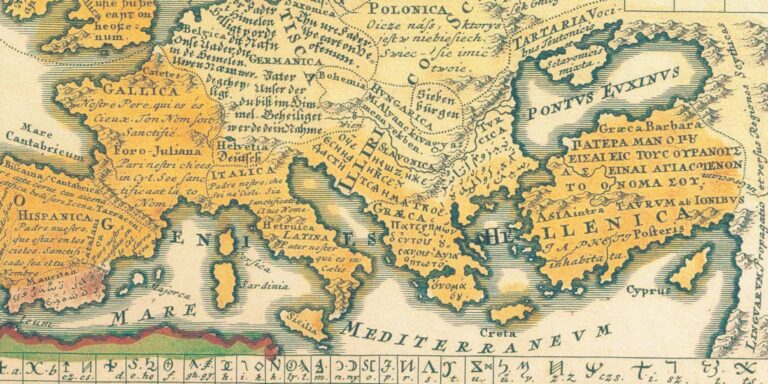
This meant that they spoke both the Italian they’d each learned from school lessons and another language at home—one called emigliän, if my map was right, although my family called it dialët. Emigliän is only one of almost thirty indigenous languages in Italy—so why had I never been told about them? In these long evenings, paled by the blue light of my laptop, I learned that Italy glittered with a mother lode of language diversity and that Vulgar Latin sprouted into many new forms across the peninsula in the Middle Ages, from the alps to Etna, as ancient Romans became the subjects of new empires and rulers.
This is not a country of Italian, bordering Spanish and French, but of entangled languages, great and small, crawling around and into each other: Occitan, Vèneto, Lombard, Furlan. But there was a catch: This linguistic wealth was fast disappearing. As I read more about it, my vocabulary began to darken with new phrases like language death, endangerment, vitality ; words that are assigned to the status of a language’s existence in the world, as if they are rare plants or pandas. And that is when the penny dropped. Deep in the long list of Italy’s endangered languages lay Nonna’s.
In the next one hundred years, up to half of the world’s languages will die. That is how many people talk about languages: They might be abstract systems of communication, but we want to give them lives, sentience, personalities. We connect them to people and places; we describe their groups and histories as family trees. Of the rich seven-thousand-plus body of thoughts, feelings, vocabularies, and grammar systems that exist today, well over three thousand languages will go. No funerals will be held; no cemeteries will fill. Some languages will leave behind dictionaries, novels, hours of radio; others will leave nothing save for a relative’s turn of phrase someone still remembers with affection.
Many linguists and language activists believe we shouldn’t call a language’s annihilation “language death” because it’s distressing for the last speakers to see their great cultural bank, intimately connected to their ethnic identity, receive a death sentence. You can also argue that it’s wrong; languages can, in theory, be revived and respoken. But what has happened in my own family, as well as in many others, has taught me a hard truth. It is simply a reality that some languages we love and identify with will never be spoken again, in our homes, our communities, or, in the most severe cases, anywhere else on our planet. Some call that death—others call it sleep, extinction, or dormancy. Whatever you want to call it, it is not the norm across human history for languages to disappear so rapidly.
Many of these endangered languages are probably varieties you’ve never heard of, but others that are definitely critically endangered include Irish, Otomi, Breton, Ainu. Linguists are unanimous that languages are disappearing at an unprecedented rate; the UN Assembly president has said that one indigenous language disappears every two weeks. A conservative estimate places the number of all the languages we’ve ever had at 31,000; a middle-of-the-road estimate puts that figure at 140,000. In the twenty-second century we will be fortunate to have 4,000 still with us.
Our ancient ancestors comfortably navigated their lives changing dialects and languages every few kilometers and enjoyed varying degrees of multilingualism. A language could signify who and what you were as much as where you lived, and a language’s fate would be tied to its speakers’ ability to survive in the face of war, disease, famine, and whatever other ancient misfortune plagued our forebears. The vast majority of the world’s languages were, and are, spoken and not written, defying most attempts to estimate and record them, but we can still get some sense of our abundant history today in certain parts of the world. Ghana, which we will visit later in this book, holds more than eighty spoken languages. Papua New Guinea has the highest linguistic diversity on the planet with more than eight hundred. China, which you may have thought of as a country that speaks Mandarin and a little Cantonese, hosts more than three hundred.
Language diversity of this level is actually normal in the grand scheme of human history, as is language shift and change; English and Hindi, once upon a time, shared a single common ancestor. Monolingualism—and the assumption that people might speak the same language over hundreds of kilometers, forever—is as manmade as the book you are reading these words in. It is increasingly normalized by a global internet that bids us to all participate—at least, if you speak one of its main languages. Forty-nine percent of the world’s top ten million websites are in English.
So why does this matter? If you stop speaking a language, surely you just speak another one instead? And what is the use of speaking a language that only sixty other people know? Well, if you’re a native English speaker, and there were just fifty-nine of you left, would you leap to Spanish, Russian, or Japanese without a second thought when a government or an occupying power told you to? Or because your parents and your teachers are convinced your old language won’t get you a job one day? For native speakers of other languages, this is not an intellectual exercise but a reality that they or their ancestors had to reckon with. Leaving a language behind is heartbreaking for any language’s speaker, regardless of their community’s size. A language is the way your parents spoke to you; it is every memory of your childhood. It roots you to your ethnic identity and values, informing all our life choices.
We lose far more than a bunch of grammar rules and words when we lose a language. We also lose the wellspring of information that flows from it—its sayings, its means of identifying and perceiving the world, its character. Languages aren’t dictionaries, but encyclopedias, containing entire worlds of often irreplaceable information. Prostratin, an enzyme found in the mamala tree in Samoa, was discovered to help treat HIV only because Paul Cox, an American ethnobotanist, was also a Samoan speaker. He learned about the tree’s healing properties from a local tribal healer who knew all about it, because it had been passed down to Samoans for generations. Many such conversations like this are yet to take place, especially in an equitable way that benefits both indigenous peoples and foreigners like Paul. In 2011, scientists estimated that 86 percent of the existing species on earth and 91 percent of species in the ocean still await description, meaning that they exist in nature but have not yet been formally observed, studied, or named by scientists.
This knowledge can be the key to studying the natural world, where Western science’s monolingualism has caused mistakes and delayed discoveries. Indigenous Americans living in the Columbia Plateau and speaking a language called Sahaptin, for example, have always distinguished two different tubers from each other—the mam ı¯n and the sasamit’a. The different words reflected their practice of commonly eating the first while avoiding the second, which was only eaten by animals. Western scientists had lumped them into the same species, but upon further examination the elders were proved right— these were two distinct tuber species. Linguist Nicholas Evans, who has documented the Iwaidja language in northern Australia, tells a similar story. He was once sitting watching a PowerPoint presentation about local animal species, alongside other linguists and Iwaidja speakers.
One of the slides showed the Australian snubfin dolphin, which had only recently been recognized by Western science as a distinct dolphin species. One of the Iwaidja men present, Khaki Marrala, casually commented that Iwaidja has always had a different word for this dolphin anyway—manimuldakbung. The snubfin was the first new dolphin species to have been acknowledged in fifty-six years, but if scientists had bothered to speak to the Iwaidja people, or learn their language, many years earlier, they needn’t have been so ignorant. The Iwaidja may know much more, but with fewer than two hundred speakers left, time is running out to ask them. The world’s biodiversity hotspots, teeming with the greatest variety of flora and fauna, also host more than 70 percent of the world’s languages. We risk losing the information that may help us preserve such places if we fail the speakers who have long been their protectors.
Along with knowledge, we also risk losing countless intangible cultural artifacts: folklore, food, songs, traditions. In the present, we feel impoverished by the loss of Sappho’s work, which we largely know about from what the great poets said of her rather than what she herself produced; we only have one complete poem from her. We are poorer without her complete work, and we are poorer still when we prevent the Sapphos of today from recording the poems they carry. Their work might be some of the only proof of a specific time and place—it could very well represent a knowledge, command, and art that will help our descendants adapt and learn, just as we do now.
We may only try to understand the lost Scandinavian language of Scotland—Norn, spoken in Shetland and Orkney and brought as Old Norse by the Vikings—because we have the Hildinakvæði, the ballad of “Hildina,” a song that a young Scottish clergyman wrote down after he heard an old farmer called William Henry singing it in 1774. This is the language these islands spoke for hundreds of years, abandoning the Pictish they used before for the language of their new Viking overlords; by the time William Henry was singing, Scots had in turn long substituted Norn in daily life. Yet people still wanted to sing in Norn; they were still drawn to Norse fatalism, with tragic heroes and untimely yet inescapable demises, known as urðr—doom. The ballad of “Hildina” is a tale of avenged romance and bloodshed, and the Norse nobility embroiled in it, gives us a window into these islands’ history and way of life where no other extant source can.
Finally, languages are crucial to our sense of identity—and, by extension, to our well-being. Groundbreaking research in Canada from the 1990s and 2000s revealed that communities where indigenous peoples could, in the majority, hold a conversation in their Aboriginal language experienced low to zero youth suicide rates. In communities where fewer than half could speak their language, suicide rates were six times higher. This isn’t surprising; a language’s health is part of self-continuity, symbolic of whether that community has also been able to hold on to their land, or access health care, education, and legal rights. In other words, languages are bellwethers of enfranchisement. This manifests in the vocabulary of indigenous groups around the world, where the Western binary of mental and physical health is challenged.
For the Māori, there is an inseparable link between someone’s health and their community’s health called taha whānau—family health—which encompasses an individual’s belonging to a community and the resilience that this provides, in addition to spiritual health. In Australia, a government inquiry in 2012 looked at how indigenous languages could contribute to addressing disparities in health and life expectancy, and the committee concluded that they were so important in closing this gap that Aboriginal and Torres Strait Islander languages should be recognized in the Australian constitution. Their recommendation has still not been ratified by the Australian government.
In short, language diversity is one of our most potent weapons against the diminishment of deep knowledge, the homogenization of culture, the erasure of history, and even some of our health crises. And yet it has never been more imperiled.
Many of us take the world’s unfathomable linguistic diversity for granted, and assume that losing a couple of languages isn’t the end of the world. But each language is a world—and we’re not just losing a couple.
We need to understand how we became so profligate with our abundant language resources and lost sight of the need to protect them. Many of us take the world’s unfathomable linguistic diversity for granted, and assume that losing a couple of languages isn’t the end of the world. But each language is a world—and we’re not just losing a couple. We’re set to lose at least half. So, if thousands of languages have existed on our planet for thousands of years, why are they disappearing faster than ever before? The short answer is that something is disappearing them.
*
When you consider a mass extinction event, you probably think of dinosaurs and comets. You may have seen a fossil in a museum, a skeletal face peering at you eyelessly from behind glass. You may have seen films with scenes of spasming lava, roaring T. rexes , the colossal, unthinkable devastation of a prehistoric time that gave way to our own life on earth. But you needn’t bother going to a museum if you want to see a mass extinction event today, and you needn’t think of big reptiles. You only need to open your mouth. Say something. You probably speak one of the world’s mega languages—you could be one of 400 million first language speakers of English or the 1 billion who speak it as their second. More than half of the world speaks 23 out of the 7,000+ known languages today. Most of these 23 languages have become dominant thanks to their colonial histories and written traditions; French didn’t become an official language in more than 20 countries by accident.
Just as history is written by the winners, languages often tend to be spoken by them, too.
Schoolchildren in Ireland and Wales in the nineteenth and twentieth centuries were forced to wear tally sticks around their necks, notched for every time they spoke their native Celtic languages, before they were hit at the end of the school day for how many notches they had accrued. The story of English is not just about Beowulf and Shakespeare; it’s also about those children being smacked daily by their teachers. It’s about colonial administrations, such as that of Whig politician Lord Macaulay, who said he wanted a class of imperial subjects in India to be English-speaking so that they could be “a class of persons Indian in blood and color, but English in tastes, in opinions, in morals and in intellect,” who, as interlocutors, could “refine” the multilingual Indian population.
These words, spoken in support of a law that would eventually be passed, allowed the British East India Company to begin teaching an English curriculum instead of a traditional Sanskrit and Persian one, a decision that would eventually lead to the cultural prominence English enjoys in India today. In a postcolonial world, such transparently racist edicts may be less commonplace. But my research into linguicide, the systemic erasure of languages, has found that not only are decisions made a century ago still having catastrophic consequences today, but that far too little is being done to reverse or even decelerate them.
In the 1980s, the Finnish linguist Tove Skutnabb-Kangas developed the idea of linguicide to highlight this. Lingu icide , she and her partner and linguist Robert Phillipson argued, was part of the “taxonomy of policies which a state can adopt toward minority languages.” For them, linguicide was not only the outright killing of a language. Letting a language die, or not supporting its coexistence, was, to them, covert language murder with similar results to overt language killing—perhaps a little like comparing manslaughter and murder. It is, of course, clear to see how a war, a genocide, or criminalization may end a community’s language and even the community itself.
But it can be more inconspicuous when a language disappears from school lessons, or political rhetoric, or watercooler conversations in offices, losing prestige in society until it’s spoken only in the privacy of homes, at kitchen tables and between loved ones. Some languages are considered more valuable than others, even in societies where we would never dream of saying one person, or culture, is of more value than another.
The delay in recognizing the severity of this loss makes a little more sense when you realize that linguistics itself is a young area of science; it took about two centuries even to get close to today’s estimation of seven thousand-odd languages. Conversations unpicking how nation-states or empires have been responsible for linguicide, or how indigenous communities may reclaim lost modes of expression, are similarly barely decades old in some countries. It has unsurprisingly been the international body that safeguards intangible cultural heritage—the United Nations Educational, Scientific and Cultural Organization (UNESCO)—that has declared this decade as the Decade of Indigenous Languages (2022-32) in a rapid awareness-raising campaign. Yet many countries fail to support multilingualism, regardless of whether that multilingualism is indigenous or the result of flourishing migrant populations. It took Italy until 1999 to create a law to care for its minority languages, managing to miss at least twenty-five of them in the process; both Gaelic and Scots were only made official languages equal to English in Scotland in 2025. Languages and linguistics degrees at universities are increasingly in decline, undersubscribed, their departments understaffed, and their research underfunded, at the very moment when we need their work more than ever.
Many of the world’s vulnerable languages are in their final generation of speakers, lingering for a little while longer before a policy, a natural disaster, or an autocrat sweeps them away. As a journalist I can see, and hope to unravel the engines of marginalization and monoculture that are literally taking the words out of our mouths. But as a granddaughter and daughter, listening to what could be the last months and even days of a language that has formed the soundtrack to my life, I hope also to show you linguicide’s great cruelty and the broken hearts it leaves in its wake. Emigliän is critically endangered, and the variety of it that my nonna speaks with native proficiency comes from an even smaller speaker set, from one specific valley in the Piacenza Apennines. This language will last a little while in my mother’s generation, and it will disintegrate not long after mine—in north London and in northern Italy, in the dense woodland where church bells ring through ever-emptying valleys.
____________________________
Excerpted from How to Kill a Language: Power, Resistance, and the Race to Save Our Words by Sophia Smith Galer. Copyright © 2026 by Sophia Smith Galer. Published in the United States by Crown, an imprint of the Crown Publishing Group, a division of Penguin Random House LLC. Published in Great Britain by William Collins, and imprint of HarperCollins Publishers Ltd.

















Comments
No comments yet — be the first to weigh in 👇
No comments yet. Be the first!