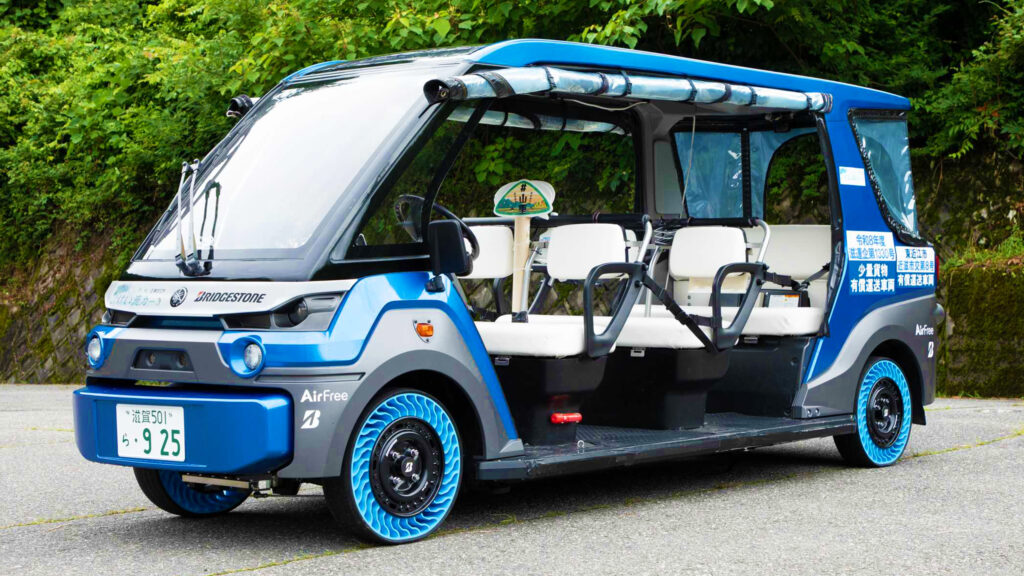
Bridgestone's airless tires debut on golf carts at 20 km/h top speed
After 18 years of development, Bridgestone has launched its airless tires commercially on self-driving golf carts for elderly residents in Higashiomi, Japan. The tires are capped at 12 mph (about 20 km/h) and are not available for ordinary passenger cars. High costs and speed limitations mean a mainstream automotive application remains far off.
Full text
Bridgestone spent 18 years getting its airless tire from prototype to street.
The debut tires run on self-driving golf carts for older residents in Higashiomi.
Cost and speed limits keep it far from ordinary passenger cars for now.
For almost two decades, Bridgestone has been chasing the formula for a workable airless tire , and after eighteen years of prototypes the company says it finally has one ready for the road. The catch is that you won’t be buying a set for your own car anytime soon, because the first commercial application is about as far from a performance application as it gets.
var adpushup = window.adpushup = window.adpushup || {que:[]};
adpushup.que.push(function() {
if (adpushup.config.platform !== "DESKTOP"){
adpushup.triggerAd("0f7e3106-c4d6-4db4-8135-c508879a76f8");
} else {
adpushup.triggerAd("82503191-e1d1-435a-874f-9c78a2a54a2f");
}
});
The tire manufacturing juggernaut has launched its new AirFree tires on a fleet of self-driving vehicles operating in the Japanese city of Higashiomi, which look like stretched golf carts. These shuttles will ferry older residents around town, so the tires won’t exactly have a hard life. Even so, this marks the first time AirFree tires have entered regular commercial service rather than a limited-duration trial.
Read: Bridgestone Launches New Dedicated EV Tires For Teslas And Mustang Mach-E
Bridgestone built its first airless tire back in 2008 and unveiled the current third-generation version in 2023, so the technology on those go-karts represents eighteen years of steady refinement. Rather than lean on a hard material that might fail or ruin ride quality, the AirFree tires use a recyclable compound strong enough to handle daily use without turning every bump into a complaint.
var adpushup = window.adpushup = window.adpushup || {que:[]};
adpushup.que.push(function() {
if (adpushup.config.platform === "DESKTOP"){
adpushup.triggerAd("ea4d4b5a-f8e5-4d5d-9d9a-53a3b956b6cd");
} else{
adpushup.triggerAd("44c0a4dc-e25b-4ba5-ac64-2c510461b92a");
}
});
The construction relies on thermoplastic resin spokes wrapped in a thin rubber tread that meets the road. Bridgestone engineer Masaki Ota said the breakthrough arrived when the team stopped trying to make the material harder and turned instead to a flexible resin and a structure that spreads loads more evenly across the tire.
Not For Road Cars, For Now
Bridgestone
The tires were shown being put through their paces on the driverless go-karts to select members of the press earlier this week. These machines were limited to just 12 mph (20 km/h). It’s unclear whether they were capped at this speed for the comfort of attending journalists, or if that’s simply the maximum safe pace at which they were built to operate. Either way, Nikkei Asia reports that for now they suit only “relatively slow vehicles.”
As a result, these AirFree tires are nowhere near ready to replace the conventional rubber that current production cars rely on. Until the technology takes a meaningful step forward, expect to find tires like these only on small mobility fleets doing low-speed work in controlled settings.
As for the color, Bridgestone calls it ‘Empowering Blue,’ and says the vibrant shade was chosen to boost visibility during the day and at dusk.
var adpushup = window.adpushup = window.adpushup || {que:[]};
adpushup.que.push(function() {
if (adpushup.config.platform !== "DESKTOP"){
adpushup.triggerAd("bb7964e9-07de-4b06-a83e-ead35079d53c");
} else {
adpushup.triggerAd("9b1169d9-7a89-4971-a77f-1397f7588751");
}
});
Bridgestone has not committed to a timeline for mass production and is currently weighing a business model that bundles the tires with services such as recycling. The company is also developing lunar rover tires built around a metal structure derived from the same AirFree design, which suggests it sees a future for the idea well beyond a Japanese retirement shuttle
var adpushup = window.adpushup = window.adpushup || {que:[]};
adpushup.que.push(function() {
if (adpushup.config.platform !== "DESKTOP"){
adpushup.triggerAd("bb7964e9-07de-4b06-a83e-ead35079d53c");
} else {
adpushup.triggerAd("9b1169d9-7a89-4971-a77f-1397f7588751");
}
});
Bridgestone
Will airless tires eventually replace conventional tires in passenger cars?
Comments
No comments yet














Comments
No comments yet — be the first to weigh in 👇
No comments yet. Be the first!