US Navy Fighter Pilots Can Still Qualify for Carrier Landings Despite Relaxed Rules
US Navy trainee fighter pilots can still complete carrier qualifications on T-45 Goshawk jet trainers, even though it is no longer a mandatory graduation requirement. Slots are available alongside E-2 Hawkeye pilot trainees and foreign student aviators, for whom carrier quals remain required. The Navy is also evaluating virtual training solutions as it prepares to replace the T-45 with a next-generation trainer that will not need to perform carrier touch-and-go landings.
Full text
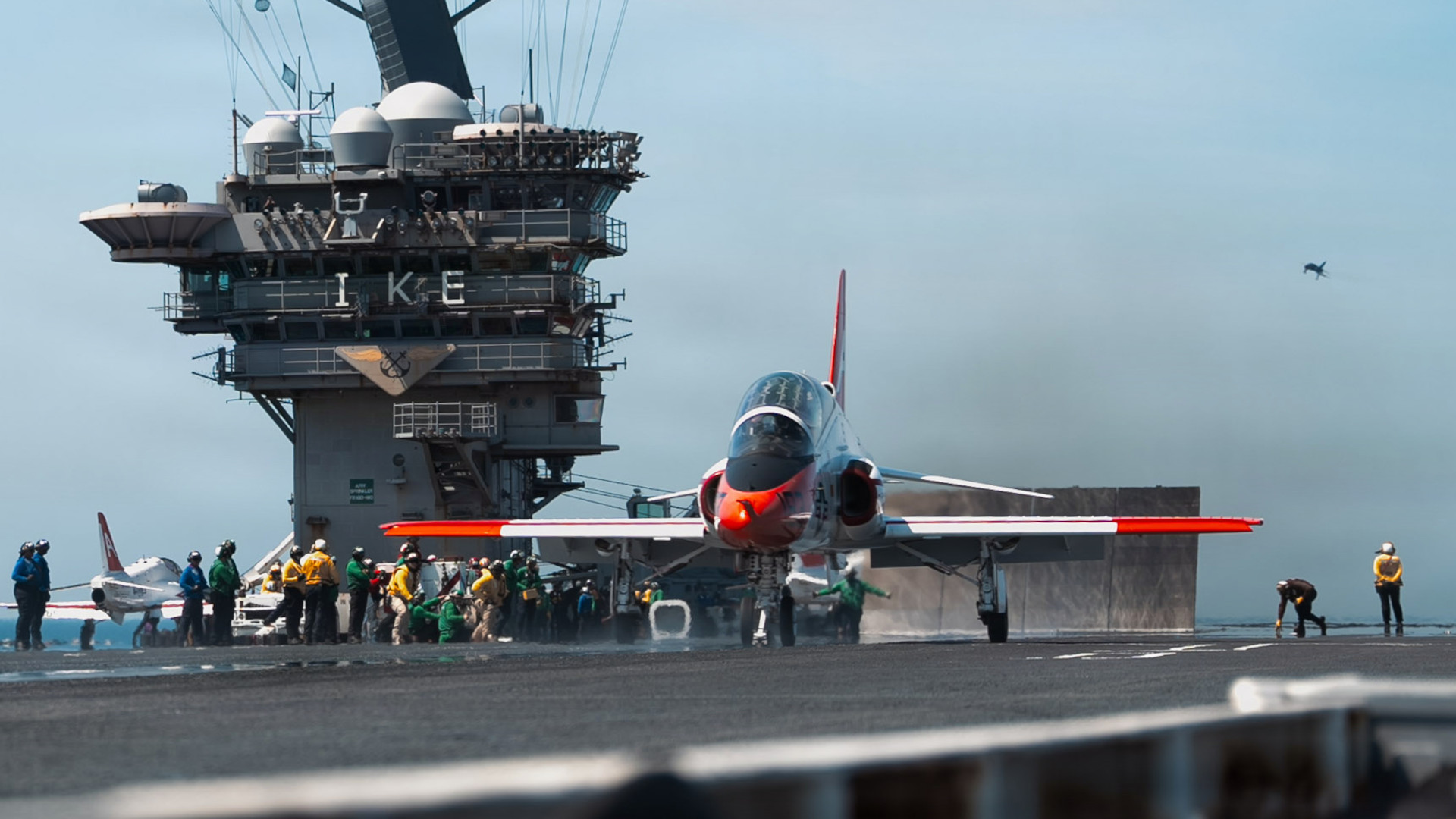
Individuals training to become U.S. Navy tactical jet pilots can still get in carrier qualifications in T-45 Goshawk jet trainers , even though it is no longer a graduation requirement . If there is time and space available, they can join future E-2 Hawkeye pilots , as well as foreign student aviators training with the Navy, for whom this is still a requirement, at least for now.
The Navy is separately in the process of evaluating new ways to ensure it can keep providing key carrier aviation training, at least in the virtual realm, as it moves ahead with plans to replace its T-45 fleet. The service’s next jet trainer will not even be required to perform carrier landing touch-and-go training .
TWZ had reached out to the office of the Chief of Naval Air Training (CNATRA) for an update on carrier aviation training plans last week. This followed the release of a new batch of pictures showing T-45s conducting carrier qualifications aboard the Nimitz class aircraft carrier USS Dwight D. Eisenhower at the end of June. CNATRA also forwarded some of our queries to Naval Air Systems Command (NAVAIR), which offered additional details about the full ‘systems of systems’ being pursued under the Undergraduate Jet Training System (UJTS) program that will take the place of the just under 200 Goshawks in inventory today.
A T-45 Goshawk seen coming in to land on the USS Dwight D. Eisenhower during carrier qualification training in June 2026. USN
“Those photos consisted of 26 student naval aviators from the following pipelines: 17 E-2 students, seven international military students and two strike students,” a spokesperson for CNATRA told us to begin with. “Carrier qualifications are not required for strike students, but if aircraft and deck time are available, we will select a small number of strike students to participate alongside E-2 and international military students.”
“Carrier qualifications remain an integral part of the E-2 and international military student training pipeline,” they added.
“The determination of when a student conducts carrier qualifications is dependent on several factors, including the student’s position in the training pipeline at the time the opportunity becomes available,” they also explained when asked for more details. “More specifically, CNATRA and the fleet determine that a carrier has the deck time and aviation assets available to support training operations, and the Training Air Wings evaluate their rosters to determine if there are students at the right phase of their training where a carrier qualification evolution is appropriate.”
As noted, as part of the UJTS effort, the Navy is already moving to acquire a new jet trainer to directly replace the T-45, which will not be required to perform carrier landing touch-and-goes or similar training called Field Carrier Landing Practice (FCLP) at facilities ashore. FCLP, as it exists now, is structured in a way that “simulates, as near as practicable, the conditions encountered during carrier landing operations,” per the Navy . This historically served as a lead-up to full carrier qualifications.
With carrier qualifications already eliminated from the strike pipeline syllabus, this prompts further questions about what will happen to the syllabus for E-2 and foreign student aviators after the T-45s are retired for good. For most prospective strike pilots, the current curriculum already means they will not touch down on a real carrier until after they are winged and flying a front-line aircraft.
“The UJTS system must be capable of training student pilots to land on a carrier,” Navy Capt. Duane Whitmer, head of the UJTS program office at NAVAIR, told TWZ in a statement. “As [the] T-45 is planned to be operational through 2040 and UJTS is currently going through source selection, any discussion regarding CNATRA carrier qualification syllabus requirements once UJTS is fielded would be premature.”
“We are essentially explaining the same requirement from different angles. UJTS is a comprehensive ‘system of systems’ encompassing both the physical aircraft and advanced simulators,” he added. “By design, this approach ensures the FCLP training capability exists within the overall program, even though the RFP [request for proposals for the T-45 replacement] does not explicitly mandate FCLP to touchdown in the aircraft itself. We are currently in source selection to evaluate how industry proposes delivering this capability across the combined system, [but] any discussion regarding future CNATRA syllabus changes remains premature.”
For years now, the Navy has made clear that it sees advances in virtualized training , as well as automated carrier landing capabilities like Magic Carpet and its successors, as having fundamentally altered the training landscape. The service has also said that eliminating FCLP and carrier qualification requirements will help move student aviators through training faster amid chronic pilot shortages . There is a cost-benefit argument to be made, as well.
Despite all this, concerns and criticism have been and continue to be voiced about the broader ramifications of cutting elements long considered critical to naval aviation training. As TWZ regularly noted, virtualized aviation training environments have become very impressive in recent years, but still cannot be expected to truly replicate live training. It’s also worth pointing out here that the Navy’s E-2 fleets also do not currently benefit from automated carrier landing developments, though the Navy is now moving to change that with a Precision Approach Landing Capability (PALC) upgrade .
“Carrier qualifications demand the highest levels of focus, skill, and teamwork,” Navy Capt. Travis Suggs, CNATRA operations officer, was quoted as saying in an official Navy news item about the training conducted on Eisenhower last month. “Watching our future pilots and our international military students successfully catch the wire aboard the Dwight D. Eisenhower is a testament to the quality of our training pipelines, the dedication of our instructors, and the immense capability of the ship’s crew.”
There remains a window for the Navy to potentially adopt something of a different approach as it firms up the rest of its UJTS ‘systems of systems’ plans. The Sierra Nevada Corporation’s (SNC) proposed T-45 replacement, called the Freedom jet , is still being designed to be capable of conducting FCLP training. SNC has also now partnered with Northrop Grumman and General Atomics on this effort.
In addition, the expectation was that removing the FCLP training requirement for the Navy’s next jet trainer would help open the field to more competitors, including ones based on types intended for operation from bases on land. However, this has not come to pass. SNC is one of just two major competitors still in the running after Boeing dropped out last month . Lockheed Martin, which had teamed with Korea Aerospace Industries (KAI), bowed out in April . A team led by Leonardo and Textron is still competing with a proposal centered on the M-346N aircraft . Both the Freedom jet and the M-346N are also notable twin-engine designs. The T-45, as well as the proposals from Boeing and Lockheed Martin/KAI, are all single-engine designs.
It is worth noting here that the Navy’s UJTS plans have already been evolving for years amid repeated delays with the program , which first emerged publicly back in 2020. The original goal was to have a T-45 replacement enter operational service in 2028. The Navy is now aiming to just pick a winning design next year, after which it will take some amount of time to complete the aircraft’s development and begin actual deliveries.
In the meantime, the aging T-45s have faced their own struggles in recent years. This includes a spate of reported hypoxia-like physiological episodes among pilots that led to the development of a new oxygen system . Engine issues have also hounded the fleet . In recent years, there have been several Goshawk crashes, some of which have been fatal, due to a variety of factors. The most recent of these came in May , but the individuals on board thankfully survived.
The Navy’s overall vision for training future aviators continues to solidify, with the new jet trainer being just one component. Just how much training ends up moving into virtualized spaces remains to be seen.
Contact the author: joe@twz.com
The post Carrier Qualifications Still Happening For A Few Navy Fighter Pilots In Training appeared first on TWZ .
Should carrier landing qualifications remain mandatory for US Navy fighter pilots?
Comments
No comments yet





/https://tf-cmsv2-smithsonianmag-media.s3.amazonaws.com/filer_public/a0/4e/a04e2328-f7ae-4afc-9bd5-815c57f68a96/735761382_979443714901375_5840206519074944984_n.jpeg)




Comments
No comments yet — be the first to weigh in 👇
No comments yet. Be the first!