Full text
Whether rain or shine, weekday or weekend, my morning starts with a scroll.
It’s one of my most enduring habits. I’ll start by checking the time, before allowing myself a few texts or emails in the name of ‘productivity’, and before long, I’m lying there watching people throwing bowling balls at TVs or reading ragebait in the comments section.
I’ve long suspected that this isn’t the optimal way to start the day, but it was only after a recent moment of mid-scroll lucidity that I began to wonder why I reach for my phone first thing in the morning.
As it happens, research on early-morning phone habits suggests that it’s not just me diving into social media as soon as the alarm goes off.
The Independent reports that 81% of Brits reach for their phone as soon as they wake up, while a 2025 YouGov report found that the majority of US adults under 30 often use their phone right before sleeping and right after waking up.
These figures could suggest that most of us shared a mental tendency to pick up the phone right after waking up, but without additional context, they can’t tell the whole story.
So, to find out more about why I and so many others scroll first thing in the morning, I spoke to two psychology experts to connect the dots between ancient human behaviour and the supercomputers we keep in our pockets, and indeed our beds.
Information vs stimulation
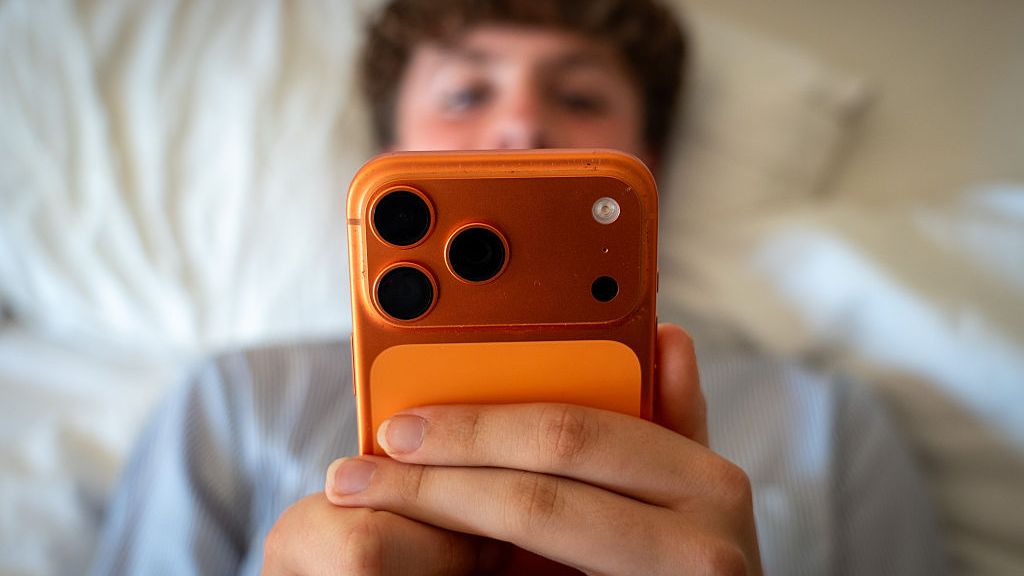
Social media offers much more information that we evolved to handle early in the morning (Image credit: Getty Images) “To boil it down as simply as possible, it’s a combination of our natural dopamine reward system and the fact that we are communal people,” says psychotherapist and addiction specialist John Puls.
Puls tells me that long-standing psychological drivers are pushing us to use our devices in the mornings, where in the past we might’ve sought different kinds of connection
“We are pleasure-seeking people, and one of the ways we do that is through engagement with our smartphones, particularly social media,” he explains, “and we want to know what’s going on in the world.”
Puls continues: “Previously, in closer communities with less technology, it wouldn’t be uncommon to just spend some time with your neighbours or your family in the morning. In the absence of that, people are looking for immediate connection, and the easiest way to do that is through the smartphone. You have to take into account the changes that have come with the smartphone, but these are natural impulses that social media is fulfilling.”
For clinical psychologist Dr. Ari Lakritz, the smartphone and all the news it connects us to fulfil an evolutionary impulse to detect threats: “The brain is somewhat hardwired to look for pertinent information, especially the more threatening information. The part of the brain that deals with that is called the amygdala — it’s one of the most ancient parts of the brain, one that’s most responsible for the fear response.”
“News sites, with their slant towards negative news, are hacking into an inborn part of ourselves,” he adds, “and when you’re looking at your phone as the first thing you’re doing, it may not be all that different from one of our ancestors scanning the horizon for threats.”
People are looking for immediate connection, and the easiest way to do that is through the smartphone.
John Puls
“We develop very early on to be aware of possible threats to ourselves, and to scan the environment for those [threats],” Lakritz continues, adding that the availability of information that may not be relevant to phone and social platform users could be increasing stress levels: “The existence of something we feel is negative or threatening in a far off country has no direct relevance to us, but we do find ourselves psychologically pulled to that.”
“It’s really assaulting people with a great deal of information that is not directly relevant to them, and definitely doing more harm than good… there’s this whole other aspect of life, which is positive news and uplifting stories that people are either not drawn to or simply not sent as much.”
Social media algorithms are blackboxed — meaning users aren’t privy to the decisions and equations that decide the content they see. With that said, it’s generally accepted that algorithms are designed to maximize engagement of any kind, and, as The Conversation reports, anger spreads more quickly through social media networks than other emotions.
As John Puls notes, this has a physical effect as well as an emotional one: “When you immediately go into your smartphone [in the morning] and start doomscrolling, so to speak, you’re releasing cortisol, a stress hormone, and your brain is getting overstimulated.”
“We’re basically in the middle of a giant experiment,” Puls continues, “our brains were not necessarily meant to be this stimulated first thing in the morning and then consistently throughout the day. Where it becomes problematic is with the risk of overstimulation — there’s a risk of constant pleasure-seeking that dulls the senses.”
Effects of the morning scroll
(Image credit: Getty Images / Cristina Quicler) According to Dr. Ari Lakritz, beginning the day with an intake of highly charged, negative information can have major effects on one’s mood and focus. He describes social media as “unlimited scrolling” of “dramatic news that can get our fight or flight response very worked up.”
“It’s really not good,” he explains, “and it very much sets the tone of one’s cognitive framing. It’s very fast, intense stimulation, whether that’s YouTube Shorts, TikTok style videos, or even just Reddit-style scrolling through very short, snappy comments or news stories.”
Lakritz continues: “If my baseline is very fast, short, intense bursts of entertainment, when confronted with something that takes more focus or deeper thinking it’ll be hard to move on from that set point.”
When asked whether early morning phone use is always problematic, Dr. Lakritz makes few exceptions: “Aside from more extreme circumstances, it’s hard to think of a good advantage one is getting with the phone right there that couldn’t be gotten in a non-technological way.”
John Puls tells me that he’s noticed that several of his clients experience discomfort when away from their phones for even short periods of time: “It almost becomes an emotional support phone — if anything happens in our life, an interpersonal problem, a problem with our relationship, we could experience that discomfort until we scroll on Instagram.”
And for young people, even higher stakes could influence phone use from dawn till dusk.
‘If they don’t exist online, they don’t exist socially’
For those born in the digital era, connection to social media can feel absolutely essential (Image credit: Getty Images) It’s worth noting at this point that I interviewed John Puls and Dr. Ari Lakritz separately, and without either knowing of the other’s involvement in this article. With that said, both professionals agreed that early morning phone use has a tighter hold — and greater impact — on young people.
“The teens that I’m working with that struggle with this, I have them check their screen time, and on average it’s between 14 and 15 hours,” says Puls, “that’s the majority of time that they’re awake.”
“Naturally, what comes with that is being pretty disconnected from people in real life [...] so there’s this pressure to constantly be online. Teens want to psychologically individuate from their families and feel part of a community, particularly with their friends. So they often feel the pressure that they can’t be part of that unless they’re on their phones.”
“For younger people, they feel that if they don’t exist online, they don’t exist socially.”
Dr. Ari Lakritz says that phone use in general has a huge impact on young people’s psychological growth: “It touches child development in a profound way. It’s a huge compound for something like ADHD, and makes assessment of ADHD very complicated — you have to piece apart how much of this is inattention issues, or developmental, and how much is very, very high exposure to electronic entertainment.”
Taking back time
Apple's Screen Time feature helps you keep track of your device usage. (Image credit: Future / Thomas Deehan) Olivia Yokubonis, known online as Olivia Unplugged, is a digital wellness strategist for Opal, one of the best-known screen time limiter apps. She tells me that she “meets people where they are” with a message of digital balance and wellbeing, sharing tips and tricks to a combined social media audience of 600,000 followers.
"I was an Opal user before I even started working here,” Yokubonis explains, “the goal is to help people stop feeling like they’re the victim of their phones, and actually feel like they’re in control again.”
“I’m not anti-technology, I’m pro agency,” she adds, “you have to focus on awareness. I’m a big advocate of the idea that we can’t change what we don’t notice. And the morning scroll is very often unconscious.”
A post shared by Olivia Unplugged (@olivia.unplugged.ig)
A photo posted by on
At the time of writing, Opal boasts more than a million daily users, and in 2026 announced that the app had saved its user base a total of 500 million hours — but Yokubonis’ strategies go further than just using the app: “Something I’ve implemented with my family is no-phone zones. The bedroom is one of those places — we put our phones in the other room, our alarms go off, and we have to get up and go get it.”
She adds: “Digital wellness means your attention is not constantly being fragmented, that you can think in complete thoughts and sentences, and that you don’t lose hours of your day, especially the first few hours of the day, without realising it [...] We need the ability to choose to go on a social media app rather than have it be a habit, or something that’s just automatically happening because my nervous system is reaching for something.”
“We have a finite amount of willpower, and these apps have an unlimited amount of resources. They are designed to use up that willpower.”
On a similar note, Dr Ari Lakritz explains that even a marginal reduction in screen time can make a big difference: “Check your screen time, add up how much you do per week, and try to cut it down by 10%. If it’s 60 hours a week, just cut off six, see what you can do. You don’t have to be a digital hermit to improve.”
Though high screen time correlates to higher revenues for many phone makers and mobile software developers, a rising tide of social media legislation and backlash against big tech could push some brands to recognise its problematic potential.
Indeed, some smartphone manufacturers are beginning to acknowledge the issue of excessive phone use, and are developing software-based features to help users curb their screen time.
Nothing, for instance, believes its Glyph Matrix and Essential Space features will ‘help you be more human’ , while Google's upcoming Pause Point tool will redirect you away from social media apps towards more meaningful forms of smartphone engagement. Apple, too, recently announced a slew of wellbeing-focused upgrades for its Screen Time feature in iOS 27 .



















Comments
No comments yet — be the first to weigh in 👇
No comments yet. Be the first!