Full text
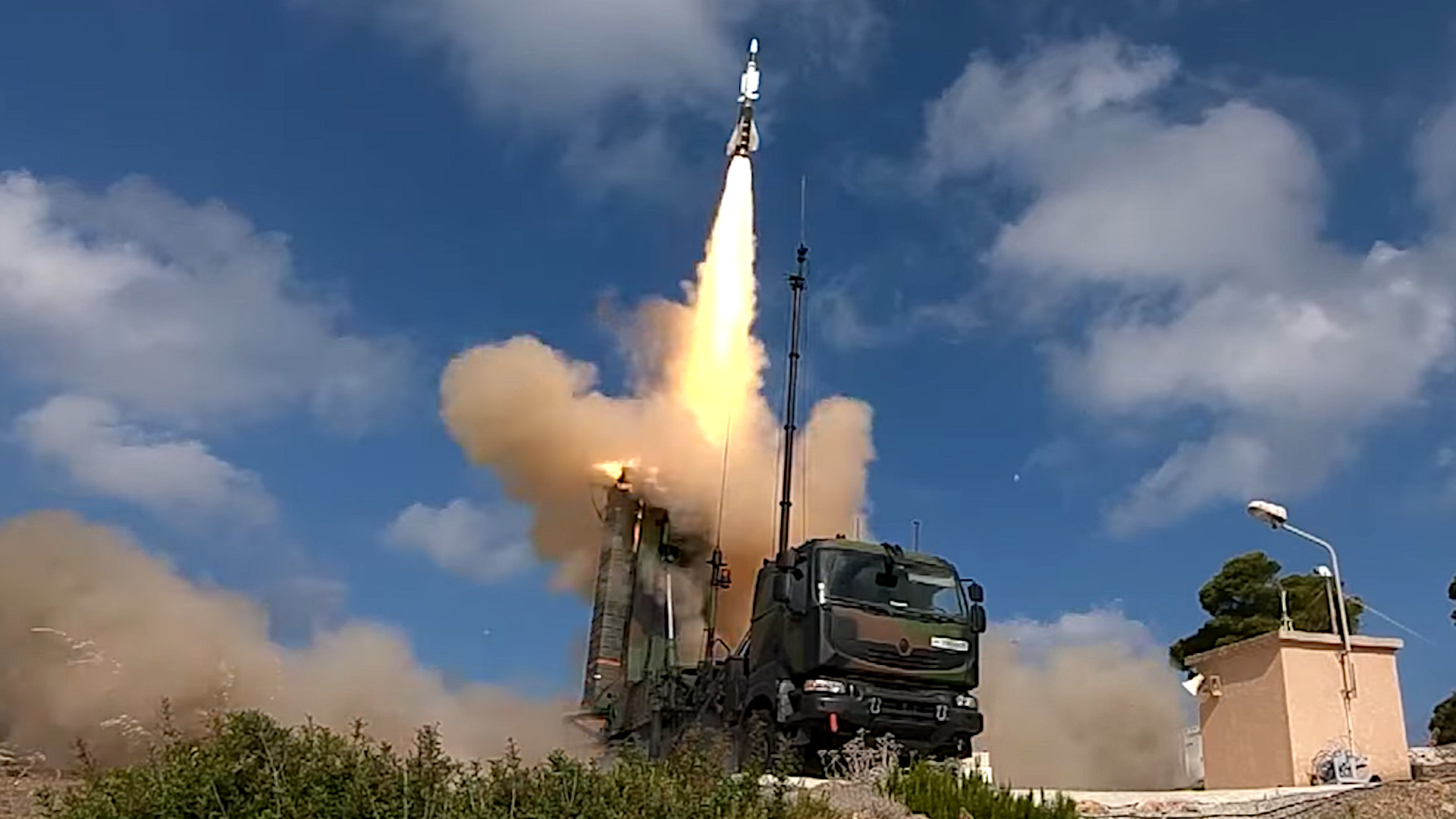
French President Emmanuel Macron says Ukraine is in line to get a license to produce Aster 30 missiles domestically. Aster 30 is the anti-air interceptor used in the SAMP/T surface-to-air missile system, examples of which are already in Ukrainian service. The Franco-Italian SAMP/T is often described as an analog to the U.S.-made Patriot , and both systems offer Ukraine vital anti-ballistic missile capability .
Ukraine is still in desperate need of additional capacity to shoot down incoming Russian ballistic missiles, especially amid shortages of missiles for its Patriots . Just last week, U.S. President Donald Trump also said he would approve a license for Ukraine to domestically produce Patriot interceptors . Significant questions remain about the exact timeline for when Ukraine might begin domestic production of munitions for either system, along with a host of other factors that will need to be addressed, as TWZ just explored in detail after Trump’s announcement regarding Patriot.
The French President spoke alongside Ukrainian President Volodymyr Zelensky, British Prime Minister Keir Starmer, and German Chancellor Friedrich Merz at a press conference at the Coalition of the Willing summit today in Paris. A total of 25 world leaders were in attendance. At this event, the governments of Ukraine, Denmark, France, Germany, Italy, the Netherlands, Norway, Spain, Sweden, and the United Kingdom also announced the creation of an Integrated Anti-Ballistic Missile Coalition. The coalition will pool resources to develop new anti-ballistic missile defense capabilities.
Ukraine will receive licenses to produce Aster-30 anti-aircraft missiles for the SAMP/T air defense system, AASM Hammer aerial bombs and SCALP cruise missiles.
President Macron:
Ukraine will get the first batch of SAMP/T missiles and 16 Rafale aircraft and the accompanying… https://t.co/CHg8hOOcqC pic.twitter.com/Hzj8zo4atP
— Anton Gerashchenko (@Gerashchenko_en) July 13, 2026
“Earlier this afternoon [Ukrainian] President Zelenskiy and I agreed on a roadmap between our two countries, implementing what had been agreed in principle last November regarding our bilateral defense cooperation,” Macron said at a press conference today, per a translation of his remarks from Reuters .
This is set to include the license production of Aster 30, as well as AASM Hammer-series precision-guided bombs and SCALP cruise missiles . France has already supplied tranches of all three of these munitions to Ukraine. It’s also worth noting that Ukrainian forces have also received Storm Shadow cruise missiles from the United Kingdom, which are nearly identical to SCALP.
Macron also highlighted planned deliveries of SAMP/T and SAMP/T NG surface-to-air missile systems to Ukrainian forces, which are set to start at least later this year. The SAMP/T NG is an upgraded version of the baseline SAMP/T type, and is designed to offer an expanded engagement envelope, both in terms of altitude and maximum range, primarily through the inclusion of new radars. The French and Italian versions of SAMP/T NG differ in the exact radar used (the French Thales GF 300 or the Kronos Grand Mobile HP from Italy’s Leonardo). Improved Aster 30 variants are also in development . Ukraine currently has two baseline SAMP/T systems, one from France and the other from Italy.
In addition, the French President talked about progress in Ukraine’s planned acquisition of French-made Rafale fighters, with the goal now being to deliver the first 16 of those aircraft in the 2028-2029 timeframe. You can read more about those plans, which were first announced last year, here .
The move by French authorities to allow Ukraine to produce Aster 30s domestically is particularly significant. Russian ballistic missiles, including ground-launched types and the air-launched Kinzhal , have and continue to present a threat that is especially difficult for Ukraine to manage . Ballistic missiles hurtle back to Earth at very high speeds in the terminal phase of flight, making them very challenging to intercept compared to other kinds of missiles, in general.
In recent years, Russia has also begun using ballistic missiles with enhanced maneuvering capabilities to make them even more difficult to knock down, even by more advanced air defense systems like Patriot. French Air Force Gen. Fabien Mandon, the chief of the French defense staff, claimed last year that SAMP/T was actually proving to be more effective than Patriot against Russian ballistic threats.
“We helped Ukraine by deploying missile and drone interception systems called the SAMP/T system,” Mandon said. “The Russians adapted the flight profiles of their most advanced missiles because they realized they were being intercepted by Ukrainian defenses. Today, the Patriot system is struggling to intercept them, but the SAMP/T is intercepting them.”
That being said, Ukraine still has more Patriot systems than SAMP/Ts, but both are in extremely high demand and short supply. The same goes for interceptors.
Patriot systems have become a cornerstone of Ukraine’s air defense since 2023.
Using PAC-3 missiles, they intercept ballistic and hypersonic threats like Iskander and Kinzhal, protecting cities and saving lives. @KpsZSU @DefenceU pic.twitter.com/TTi8PCAEsM
— UNITED24 Media (@United24media) April 4, 2026
“Our warriors performed well today in intercepting drones and cruise missiles, but unfortunately not Russian ballistic missiles. And the reason is precisely the insufficient supplies of interceptor missiles,” Ukrainian President Zelensky wrote in a Ukrainain language post on X on July 6 after an especially heavy barrage on the capital Kyiv, according to a machine translation. “It is extremely important for the world, first and foremost America and our European partners, to emerge from the NATO summit in Ankara with strong decisions to support our air defense, and thus the protection of ordinary people’s lives. As long as missiles for ‘Patriots’ remain in the warehouses of allies, it only encourages Russia to continue ‘defeating’ residential buildings. The United States and Europe have enough power to stop this terror.”
Цієї ночі Київ був під масованим російським ударом. Росія випустила 68 ракет і ще 351 ударний дрон. Зараз триває ліквідація наслідків. Пошкодження зафіксовані більш ніж на 10 локаціях міста, зокрема в житлових будинках. На місцях працюють усі необхідні служби, які роблять… pic.twitter.com/cf2vZzOZy2
— Volodymyr Zelenskyy / Володимир Зеленський (@ZelenskyyUa) July 6, 2026
Patriot and SAMP/T may offer important capabilities against other aerial threats , including Russia’s Zircon missile . Zircon is widely described as an air-breathing hypersonic cruise missile . However, the question has been raised recently about whether it might actually be a more traditional quasi-ballistic weapon .
At the same time, demand for higher-end surface-to-missile systems and anti-ballistic missile capability, and suitable interceptors, is growing across Europe and elsewhere globally. This is underscored by the announcement today of the new Integrated Anti-Ballistic Missile Coalition. This, in turn, reflects a similar surge in the development and fielding of ballistic missiles around the world, including by smaller countries and even some non-state actors . The conflict with Iran this year , as well as fighting with Iranian-backed Houthi militants in Yemen in recent years and the ongoing conflict in Ukraine , have only further driven home the growing capabilities and proliferation of ballistic threats.
This reality applies even to the U.S. military, where the Marine Corps is now looking to acquire an organic ballistic missile defense capability to reduce reliance on the Army to provide this support. For years now, TWZ has been calling attention to how the Army’s Patriot force is heavily strained due to constant demands and is simply not adequately resourced to meet the current operational needs. That service is working to address those shortfalls, but it will take years for those efforts to come fully to fruition.
So, for Ukraine, having its own domestic pipeline for an interceptor like Aster 30 would offer an immensely valuable hedge against shortages and delays elsewhere. For this particular missile, demand extends beyond SAMP/T operators, which also currently include Singapore. Warships in service with the navies of France, Italy, the United Kingdom (where it is part of the Sea Viper air defense system), and several other countries are also equipped to fire these interceptors.
High demand for Patriot interceptors and full Patriot systems in Ukraine has already had negative downstream impacts on orders for other customers. Concerns have been raised about the sufficiency of U.S. military stockpiles as a result, something that has been further compounded by heavy U.S. and allied expenditures in recent fighting in the Middle East.
At the same time, there are still questions about how and when domestic production of Aster 30 or Patriot interceptors in Ukraine might begin, or when the first missiles might start being delivered. Higher-end anti-air missiles typically have production lead times measured in months, if not years. It will take some time for Ukraine just to finalize deals with the relevant defense contractors and establish a domestic production line. Where initial funding might come from is not entirely clear, either, though new financial aid from France and other countries could be a definite possibility. Ukraine might potentially be able to export some of the interceptors it produces, offering a badly needed economic boost for the country.
There is also an operational security question. Russia or other adversaries could gain valuable insights into the capabilities of SAMP/T or Patriot if they were to get their hands on full-up interceptors or even just critical subcomponents. There is already a certain danger taken in delivering more advanced missiles to a country at war. Even wreckage can be an intelligence gold mine for the enemy, depending on what is recoverable . Establishing a full domestic production line will require stockpiling of brand-new subsystems, as well as the sharing of at least some degree of intellectual property and manufacturing know-how. All of which increases the total number of potential risk vectors in a country that is, again, at war with its neighbor, which also happens to be a near-peer threat for the United States and others in the West.
Macron’s announcement about licensing Aster 30 production today does not address Ukraine’s critical immediate needs for more high-end interceptors now to respond to incoming Russian ballistic missiles. At the same time, it does open up an important new path to keeping a steady supply of missiles for the Ukrainian military’s growing number of SAMP/T systems down the road. These are also capabilities Ukraine will need in the long-term, well beyond the current conflict, to help deter future aggression.
Contact the author: joe@twz.com
The post Ukraine Getting License To Build Aster 30 Anti-Missile Interceptors appeared first on TWZ .













Comments
Join the discussion — what's your take?
No comments yet. Be the first!
ngl that escalated
Report