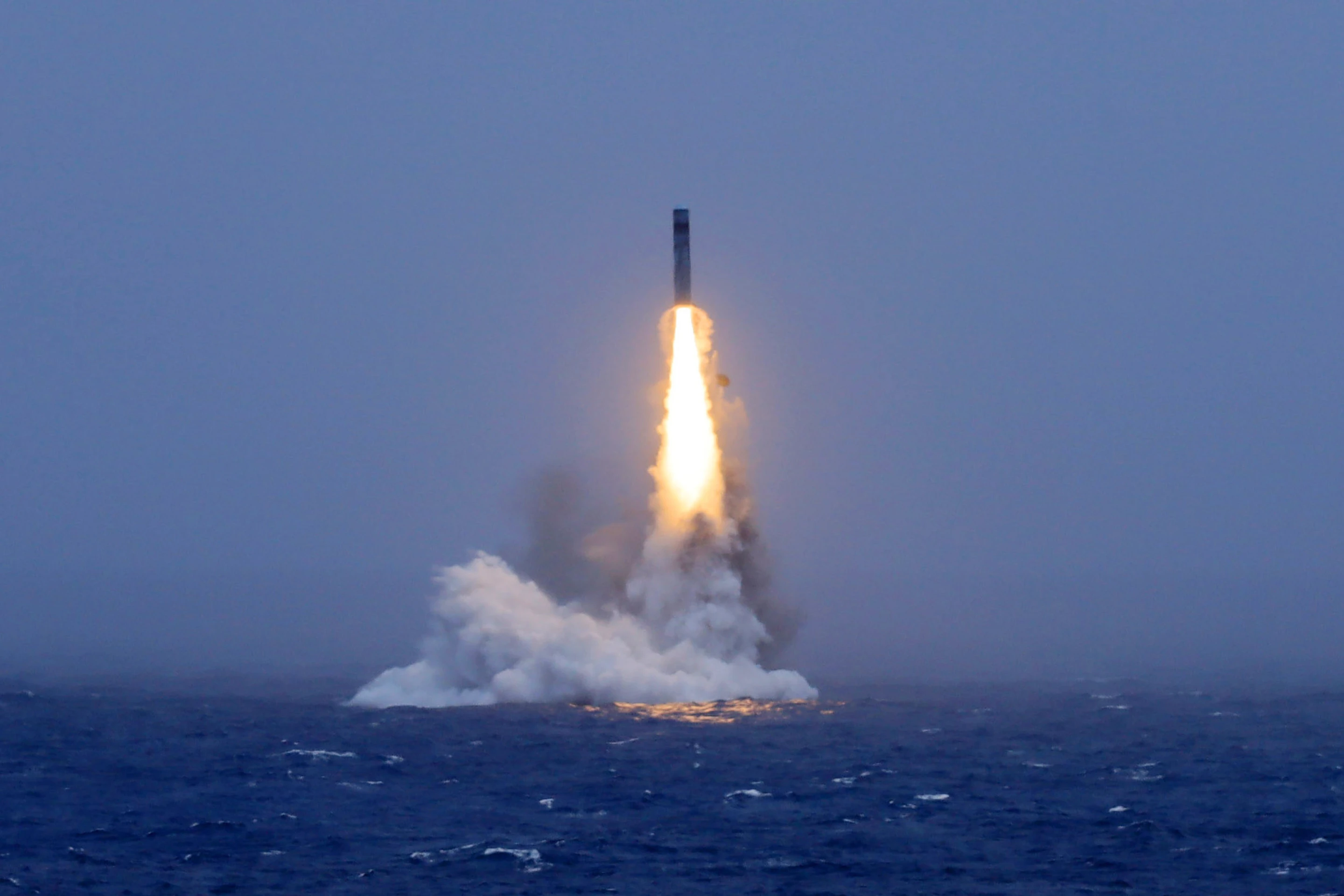
China tests coast guard patrols and submarine-launched ICBM as long-term deterrents
In June, China deployed coast guard vessels to patrol the Pacific Ocean east of Taiwan and weeks later test-fired a submarine-launched ballistic missile from the South China Sea. Analysts say both moves represent new, long-term strategies to deter U.S. allies from challenging China's territorial claims rather than one-off shows of force. The coast guard formation, positioned 100 km from Taiwan, is seen as police activity but analysts warn it may become a permanent fixture of Chinese pressure on the island.
Full text
NEW TAIPEI CITY, Taiwan — China sent coast guard vessels to patrol the Pacific Ocean east of Taiwan in June and weeks later test-fired a submarine-launched ballistic missile from the South China Sea to the Pacific.
While the two maneuvers answered different security-related activities by U.S. allies in Asia, experts say China used both to try out new, attention-grabbing and long-term ways to deter others from challenging its territorial claims.
The Chinese Coast Guard vessels in waters east of Taiwan since May are meant as police activity rather than more provocative four years of sporadic naval or air force drills around the self-ruled island that Beijing claims as its own, analysts said. China has threatened to take Taiwan by force, if needed.
But a white-hulled vessel formation’s continued presence 54 nautical miles (100 kilometers) from Taiwan shows signs of becoming a long-term exercise – something that hasn’t been tried before – rather than a quick pass-through by armed forces, they said.
“That China uses the coast guard instead of the navy and air force is probably to reduce the threat profile of the exercises, so as to be able to claim restraint rather than escalating to the level of the formal military,” said Brian Hioe, a non-resident fellow at the Taiwan Research Hub of the University of Nottingham.
“Nevertheless, China increasingly integrates civilian and military forces, making it harder for other countries to respond to grey-zone activity,” Hioe said.
Large coast guard ships are designed for “longer deployments” than what naval vessels normally do, said Joshua Arostegui, chair of China studies and research director of the China Landpower Studies Center at the U.S. Army War College’s Strategic Studies Institute.
“That’s kind of the big takeaway,” Arostegui said.
The rotation between two vessel formations on July 4, China’s description of the mission as a sustained one and its stated intent to keep strengthening patrols “all point in one direction”, said Sophie Wushuang Yi, postdoctoral teaching fellow with Schwarzman College at Tsinghua University. That, she said, is “routine.”
Beijing’s Taiwan.cn website said on July 10 its coast guard was sustaining “routine law enforcement patrols” as the new vessel formation took over.
Taiwan’s Mainland Affairs Council, a government ministry, said on July 4 that the vessels were violating international law and “damaging regional stability”.
China’s initial patrols responded to maritime boundary negotiations between Japan and the Philippines, both of which are near Taiwan, experts said. They pointed to a Chinese government condemnation of the talks.
Taiwanese and Chinese coast guard units may find “confusion” along their respective routes if China keeps up its patrols, said Enrico Cau, an associate researcher at the Taiwan Strategy Research Association think tank.
Taiwan and Japan, maritime neighbors and historic de-facto allies, may respond with their own coast guards, Hioe said, while the United States could carry out “freedom of navigation” operations with other militaries in the Asia Pacific.
Those operations mean sailing warships through disputed or restricted international waters to indicate that Washington considers the channels open to all.
Meanwhile, the July 6 missile test, China’s first submarine-launched strategic missile into international open waters, drew statements of protest from Australia, Japan, New Zealand, the United States and some South Pacific island leaders.
The missile carried a simulated training warhead for 7,300 kilometers and likely overflew parts of the Philippines, the Washington-based Center for Strategic and International Studies said in July 7 commentary.
Though the test took place on the same day U.S. ally Australia signed a defense treaty with Fiji, analysts said Beijing set out mainly to warn multiple countries of what it could do in case of a nuclear attack in the disputed South China Sea.
“I don’t think it’s a new strategy as much as demonstrating its ability to have a nuclear triad basically,” Arostegui said. The triad includes land-based ICBMs, long-range bombers and submarine missiles, he said, with subs hard to detect and intercept.
The ballistic missile test specifically warned of what could happen if other countries build up military positions in the Indo-Pacific, Cau said.
“In particular it might be aimed at curbing any intention of regional powers harboring the ambition to either develop or host nuclear capabilities, Japan in primis,” he said.
Beijing also hoped the launch of its JL-2 or JL-3 ballistic missile would help test equipment and prove to other countries it has nuclear strike capability, the Center for Strategic and International Studies said.
It probably timed the sub launch for the 13th China-Russia Joint Sea 2026 exercise, “broadly consistent with China’s desire to portray Sino-Russian strategic alignment through coordinated military activities,” the think tank’s report says.
Expect more, Yi from the Schwarzman College said.
“I would expect such launches to become periodic but rare,” she said. “What the navy is proving, in my assessment, is that its sea-based deterrent is not merely symbolic but operational.”
The tests would be “consistent with the PLA-wide requirement of being ‘able to fight and win,’” she added.
China’s official Xinhua News Agency called the missile test part of an annual military training program and said the government had notified “relevant countries” in advance.
Do China's actions toward Taiwan represent a genuine military threat?
Comments
No comments yet














Comments
No comments yet — be the first to weigh in 👇
No comments yet. Be the first!