Full text
Archaeologists in Russia have discovered a rare medieval wild-boar tusk that was likely used by a warrior or noble as a good-luck charm, a new study reports.
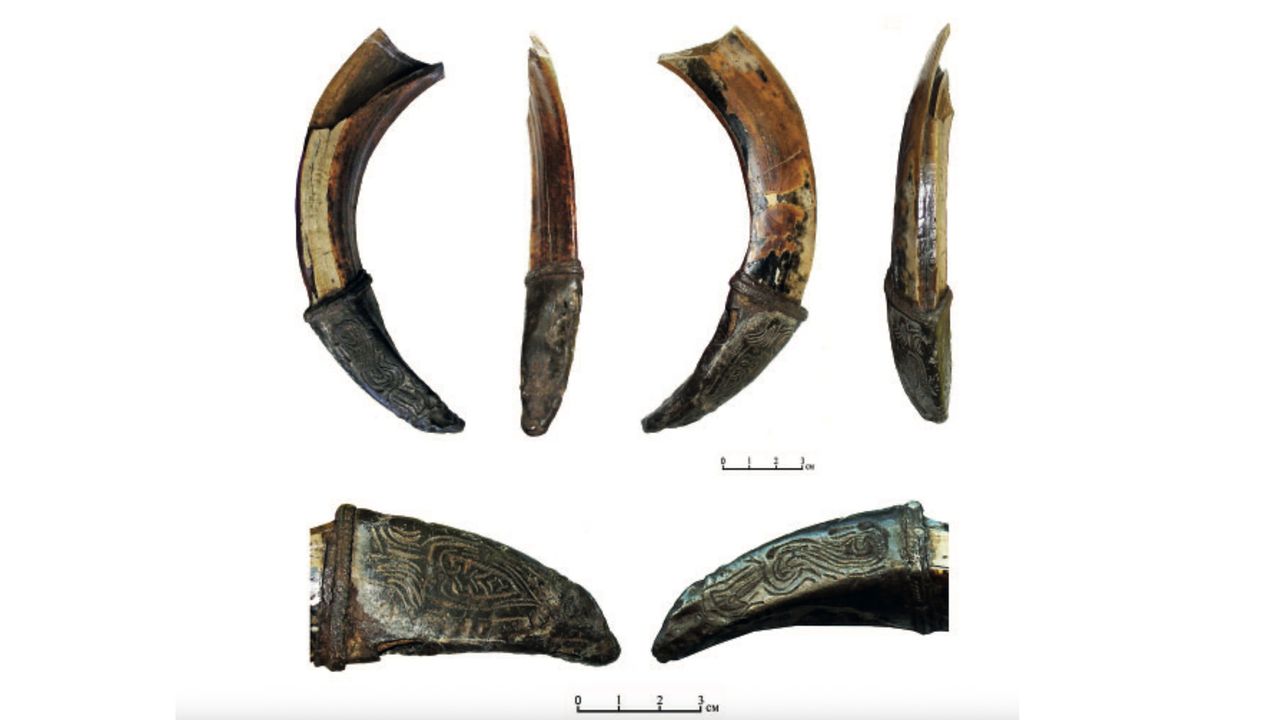
The unusual finding, a large tusk mounted with an engraved metal cap, dates to between the mid-12th and early 13th century. It was found in Novgorod the Great (also called Veliky Novgorod or Novgorod), one of the oldest major towns in Russia. One characteristic of the amulet, in particular, stood out.
"It's extraordinary because of its size. It's extremely big," Natalia Eniosova , co-author of the study and a metal scientist in the Department of Archaeology at Lomonosov Moscow State University, told Live Science. The tusk isn't complete, but the length of what's left is 3.9 inches (10 centimeters) long, with the widest point measuring 1.1 inches (2.8 cm) across. She and her colleagues' research revealed that the tusk came from a wild boar that was at least 8 years old and weighed over 220 pounds (100 kilograms).
"Such an animal would not have been hunted for food," she said, explaining that domestic pigs were a more practical and common food source at the time. The wild boar may have been eaten anyway, but the team doesn't know for sure.
Another trait that makes the amulet unique is its mount. While it looks like it's made of silver, Eniosova was surprised to find that it was almost 100% tin — specifically, a silver-imitating tin-lead alloy. Just like today, tin wasn't as valuable or as expensive as silver, but because there weren't many tin sources in Europe at the time, it was still rare.
A close-up of the tin mount and its engraved decorations. (Image credit: Tyanina E.A. et al. The Volga River Region Archaeology (2026)) It's interesting that such a soft material was carved with engraved decorations, Eniosova pointed out. "It wouldn't have been easy, and this ornament is quite elaborate," she said. "It's a very, very well-done object."
All of these unusual characteristics seem to align with the artifact's discovery in a part of the Troitsky XVI excavation area that would have been inhabited by wealthy individuals. In fact, it was probably a hunting trophy belonging to an aristocrat, noble or military man, Eniosova said.
Historical texts report that wild-boar hunting in medieval times in what is now Russia was a privilege of the "druzhina," or military retinue, and the nobility, according to the study, which was recently published in the journal The Volga River Region Archaeology . Regardless of whether the wild boar was eaten, at least one of its tusks was extracted and then mounted with metal. The team thinks it was kept as a good-luck charm, mostly because of its size.
"It is highly probable that this mounted tusk functioned as a martial or hunting talisman," the researchers wrote in the study. "It symbolized the transfer of the beast's physical prowess to the hunter and served concurrently as a charm for good fortune."
Similar animal amulets with holes at the top, worn as necklaces, were popular in Veliky Novgorod during this time period, Eniosova noted. The newfound wild-boar tusk is missing its top part, but it may have once had a hole.
A close-up of an engraved ornament on the boar tusk's mount. (Image credit: Tyanina E.A. et al. The Volga River Region Archaeology (2026)) It still would have been a rare object, however. Boar tusk amulets were common in earlier periods, but they were very rare between the second half of the 11th century to the first half of the 13th century, despite the enduring widespread belief that these tusks had magical qualities.
The amulet could be linked to Scandinavian mythology, according to Eniosova. Indeed, some of Veliky Novgorod's first settlers were from Scandinavia. But the amulet was created over 150 years after they left the area, so the relation is hypothetical, Eniosova said.
Related stories
Archaeologists discover that parties 11,000 years ago were BYOB — bring your own boar
'We got evidence of boars, deer, bears, aurochs': Ancient DNA reveals sunken realm Doggerland had habitable forests during the last ice age
Warty pig is oldest animal cave art on record
Veliky Novgorod first appears in historical documents in the ninth century and was a major trading hub in the medieval polity known as Kievan Rus. Archaeologists theorized that at the time the boar tusk amulet was made, the city was inhabited by landowners and/or people involved with the fur trade, Eniosova said.
The finding is a "highly significant and unusual discovery," Alexei Gippius , a philologist at HSE University in Moscow who is familiar with Novgorod archaeology, told Live Science in an email.
Gippius, who knows the researchers but wasn't involved in the new study, added that the research sheds "new light on the origins and functioning of the mythological beliefs of the early Rus elite."












Comments
No comments yet — be the first to weigh in 👇
No comments yet. Be the first!