Full text
Alfa Romeo’s 164 sedan served as a base for unconventional builds.
The Museo Alfa Romeo vault holds a pickup and a mid-engined racer.
Both the Proteo and Scighera concept cars borrowed the sedan’s DNA.
The Alfa Romeo 164 sits at a hinge point in the company’s modern history, the final car the Biscione engineered under its own direction before Fiat took the keys. What gets lost in that footnote is how far the Pininfarina-styled flagship strayed from its executive-sedan brief. I found two of them at the Museo Alfa Romeo, and between them they make the case better than any spec sheet. One is a chopped two-door pickup. The other is a V10 racing car with almost nothing underneath it a 164 owner would recognize.
var adpushup = window.adpushup = window.adpushup || {que:[]};
adpushup.que.push(function() {
if (adpushup.config.platform !== "DESKTOP"){
adpushup.triggerAd("0f7e3106-c4d6-4db4-8135-c508879a76f8");
} else {
adpushup.triggerAd("82503191-e1d1-435a-874f-9c78a2a54a2f");
}
});
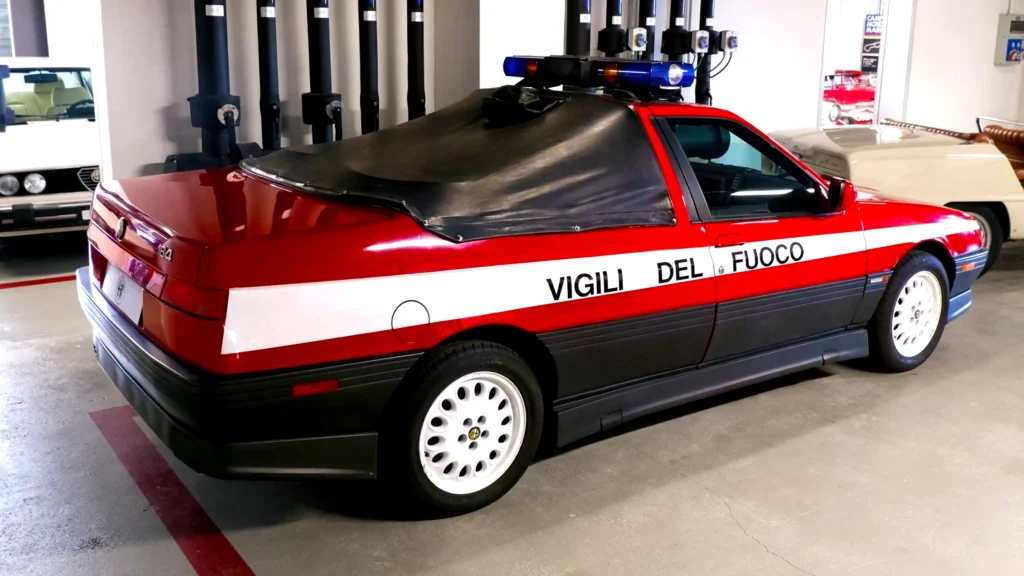
Starting with the pickup, the story of Alfa Romeo’s firefighting fleet traces its roots to the Balocco proving ground, which opened its doors in 1962. To provide support for high-speed testing incidents , the track employed firefighters equipped with custom vehicles developed by the internal skunkworks division known as the Alfa Romeo Reparto Esperienze.
More: Take A Ride With Me To Alfa’s Homeland In Its Smallest SUV, Sins And All
After building Vigili del Fuoco conversions of the 1750 Berlina, the Alfetta, the Alfa 6, and the Giulietta sedans, the team applied the same treatment to the 164. The donor vehicle was the high-performance all-wheel-drive Quadrifoglio 4 variant, fitted with a 3.0-liter V6 engine that was good for 229 hp (171 kW / 232 PS).
var adpushup = window.adpushup = window.adpushup || {que:[]};
adpushup.que.push(function() {
if (adpushup.config.platform === "DESKTOP"){
adpushup.triggerAd("ea4d4b5a-f8e5-4d5d-9d9a-53a3b956b6cd");
} else{
adpushup.triggerAd("44c0a4dc-e25b-4ba5-ac64-2c510461b92a");
}
});
Alfa Romeo 164 Vigili del Fuoco | Photos Thanos Pappas / Carscoops
Emergency duty meant taking a saw to the rear section of the roof, which turned the 164 sedan into a pickup with a bed behind the cab. That space went to heavy-duty hoses and water pumps, kept out of sight beneath a soft aerodynamic cover that stopped the load from wrecking the aerodynamics on the way to an incident. Furthermore, the Vigili del Fuoco got emergency lights on the roof, and a special livery with white decals on the red bodywork.
More: Alfa Romeo 164 Restomod Looks Gorgeous With Telephone-Dial Wheels And Carbon Bodykit
When it was retired, the one-off pickup model went to the museum, preserving a forgotten corner of Alfa Romeo history.
The Mid-Engine V10 Racecar
var adpushup = window.adpushup = window.adpushup || {que:[]};
adpushup.que.push(function() {
if (adpushup.config.platform !== "DESKTOP"){
adpushup.triggerAd("bb7964e9-07de-4b06-a83e-ead35079d53c");
} else {
adpushup.triggerAd("9b1169d9-7a89-4971-a77f-1397f7588751");
}
});
Alfa Romeo 164 ProCar | Photos Thanos Pappas / Carscoops
The second special 164 I encountered at the Museo Alfa Romeo shares even less with the production sedan. This one was built in 1988 for ProCar, the Formula S championship the FIA floated as a support series for Formula 1 weekends. It died before a single race, largely because Alfa Romeo was the only manufacturer that bothered to commit.
More: Reborn Alfa Romeo 155 Race Car Is Really A Giulia QV In Disguise
The rules required each car to keep the silhouette of a road-going model, which is why the Alfa Romeo 164 ProCar passes for a hot version of the sedan from a distance. Underneath, it has nothing to do with one.
The model is based on a bespoke carbon fiber tub chassis developed by Brabham, allowing a total weight of 750 kg (1,653 lbs). Power comes from a mid-mounted naturally-aspirated 3.5-liter V10 engine originally engineered for the Ligier F1 team, producing an impressive 620 hp (462 kW / 629 PS). While it never raced, the mid-engine sedan made a public appearance at the 1988 Italian Grand Prix at Monza.
var adpushup = window.adpushup = window.adpushup || {que:[]};
adpushup.que.push(function() {
if (adpushup.config.platform !== "DESKTOP"){
adpushup.triggerAd("b25ecba7-3bbb-4ea7-a3a8-dbea91695c07");
} else {
adpushup.triggerAd("e46c436a-adeb-4b5e-a2c7-56bc36561c10");
}
});
The Concepts
1991 Alfa Romeo Proteo Concept | Photos Thanos Pappas / Carscoops, Stellantis
The pickup and the racecar are strange enough to carry a story on their own, but the 164 platform also spawned a pair of concepts worth accounting for.
More: I Gave Alfa’s Last Busso V6 Coupe A Digital Restomod, Then Let The Purists Judge It
The 1991 Alfa Romeo 164 Proteo concept was designed by Walter de Silva, adopting a two-door silhouette that could transform from a coupe into a convertible thanks to a folding glass top. The concept used a shortened version of the sedan’s platform and was powered by a 3.0-liter V6 engine, featuring all-wheel-drive and four-wheel-steering. Although it never reached production, its design influenced the GTV and Spider sports cars.
1997 Alfa Romeo Scighera Concept | Photos Italdesign
The 1997 Scighera is the outlier here, since it lives at Italdesign headquarters rather than the museum. It was envisioned as a roadgoing supercar accompanied by a racing version. The low-slung body with the removable gull-wing windows was made of aluminum for the road car, while the track-focused GT variant utilized carbon fiber panels. Under the skin it used components from the 164 architecture with a mid-mounted twin-turbo 3.0-liter V6 producing 400 hp (298 kW / 406 PS) and an AWD system derived from the 155.
The sedan that started all of this arrived in 1987 wearing Pininfarina bodywork, its FWD and AWD platform co-developed with the Saab 9000, Lancia Thema, and Fiat Croma. It sold well by Alfa standards and stayed in production until 1997, when it got replaced by the 166.
Alfa Romeo 164 | Photos Stellantis
















Comments
No comments yet — be the first to weigh in 👇
No comments yet. Be the first!