Full text
The main job of the U.S. Air Force’s growing fleet of F-15EX Eagle IIs has been and continues to be air-to-air combat, especially in defense of the U.S. homeland . However, operational and test units are laying the groundwork for F-15EXs to also take on air-to-ground missions.
Despite its primary mission set, air-to-ground capabilities are inherently a part of the F-15EX’s design. The Eagle II is a member of the extended F-15E Strike Eagle family, having been derived from the F-15QA developed for Qatar .
Last week, the Oregon Air National Guard’s 142nd Wing shared that one of its F-15EXs had dropped training bombs for the first time ever during a trip to Mountain Home Air Force Base in Idaho back in May. The 142nd, based in Portland, Oregon , is currently the Air Force’s only operational unit flying the Eagle II.
A stock picture of one of the 142nd Wing’s F-15EX Eagle IIs. USAF
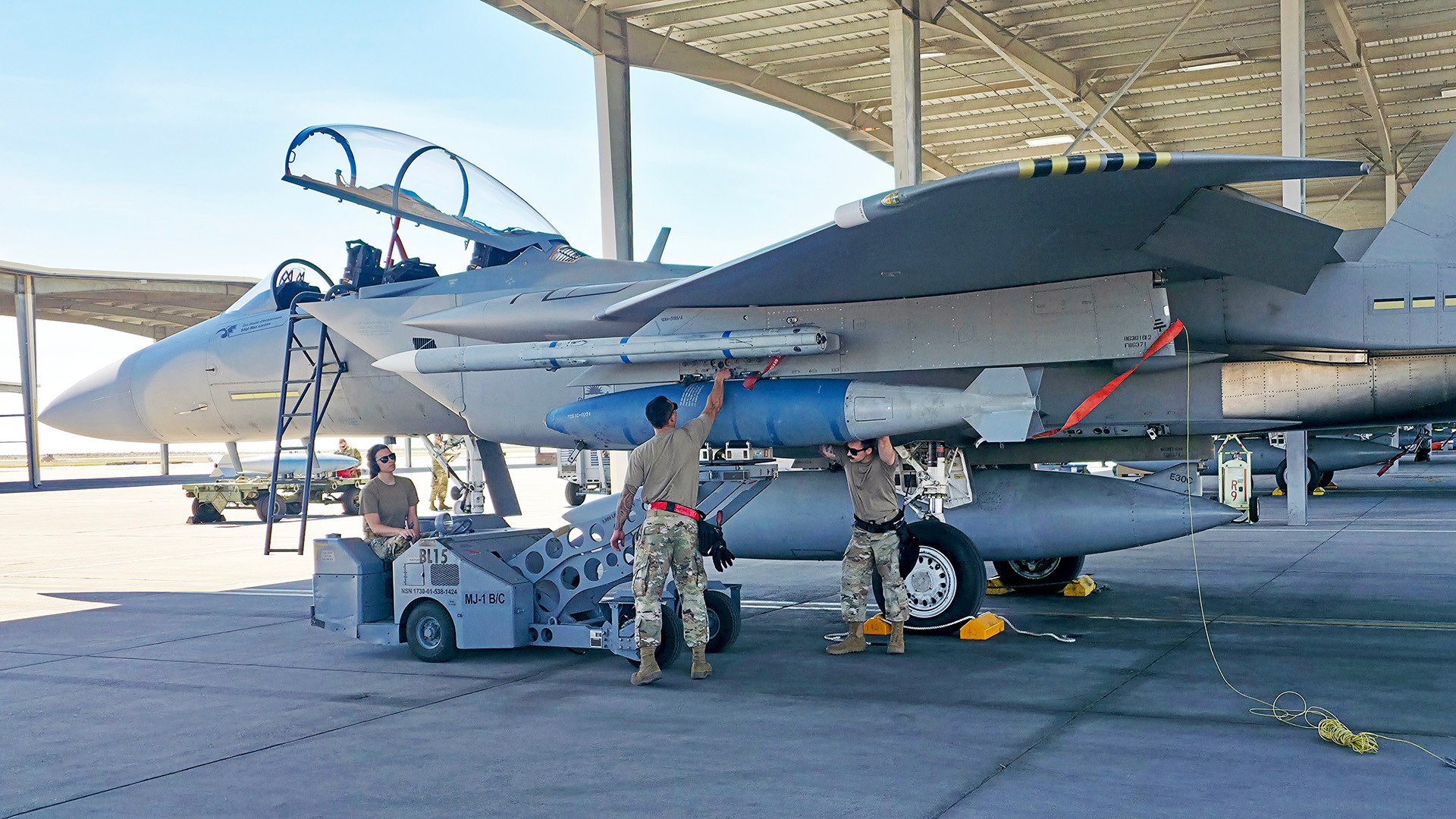
“The crew dropped a total of 24 BDU-50s and 12 BDU-56s over 10 missions with zero safety incidences and satisfactory scores,” according to an official release . “These ‘bombs’ were loaded onto the F-15 EXs and dropped in the Mountain Home firing range complex.”
The BDU-50/B and BDU-56/B are inert training bombs with the same shape and weight as live 500-pound-class Mk 82-series and 2,000-pound-class Mk 84-series bombs, respectively. In U.S. service today, bombs in the extended Mk 82 and Mk 84 families are far more commonly employed in combination with Paveway laser guidance or Joint Direct Attack Munition (JDAM) GPS-assisted guidance kits.
The BDU-50s and BDU-56s are still useful tools for training more general ‘dumb bombing’ skill sets for aircrew and for handling of air-to-ground weapons on the ground. This includes things like going through the procedures for targeting and safe release from an aircraft, as well as loading and unloading the bombs from planes.
A stock picture of a pair of BDU-50/Bs on a dolly about to be loaded onto an F-15E Strike Eagle during training. USAF
Basics are especially important for the members of the 142nd, which previously flew F-15C Eagles with no operational air-to-ground capability. It’s also worth noting here that the F-15C was a single-seat type, while the F-15EX is a two-seater. However, the Air Force’s plan, at least initially, has been for a single pilot to fly the Eagle II, something we will come back to later on.
The 142nd does have some personnel with air-to-ground mission experience from prior assignments, but this is still a new mission set for the unit as a whole, which requires new training regimens.
Three pilots from the 142nd “attended a 9-month training course to understand the science behind dropping bombs and the tactics involved. They were tasked with creating a program to train the rest of the wing’s pilots on the basics so they could make the first steps to be able to drop munitions,” according to the official release. Earlier this year, weapons loaders from the Wing also “traveled to Nellis Air Force Base, Nev. where they worked with F-15 E-models assigned to the 59th Test and Evaluation Squadron to become certified on loading bombs.”
The Air Force’s Test and Evaluation community has already been validating the F-15EX’s air-to-ground capabilities . This testing is now extending overseas. Earlier this month, the 85th Test and Evaluation Squadron brought an Eagle II from Eglin Air Force Base in Florida to Kadena Air Base in Japan to support a munitions load training event. An F-15E Strike Eagle also took part in that training. Pictures the Air Force released on Monday show that live GBU-53/B Small Diameter Bomb IIs (SDB IIs), also known as StormBreakers, were among the munitions that ground personnel at Kadena practiced loading onto the jets.
GBU-53/B Small Diameter Bomb IIs sit on a dolly in front of an F-15EX from the 85th Test and Evaluation Squadron during a training event at Kadena Air Base, Japan, on July 8, 2026. USAF
Airmen assigned to the 67th Fighter Generation Squadron prepare to load GBU-53/B Small Diameter Bomb IIs onto an F-15EX Eagle II assigned to the 85th Test and Evaluation Squadron at Kadena Air Base, Japan, on July 8, 2026. USAF
Two active duty squadrons of F-15EXs are set to be established at Kadena , taking the place of units previously based there that had flown F-15Cs. The Air Force has been deploying F-15Es and other fighters to the base on a rotational basis to fill the gap in the meantime.
The Air Force has previously announced plans to stand up National Guard F-15EX squadrons in California, Louisiana , and Michigan . The service’s proposed budget for the 2027 Fiscal Year outlines plans to dramatically expand the total size of the Eagle II force, which could lead to a dozen squadrons or more flying the jets in the end, as you can read more about here . How this might change the Air Force’s plans for employing the jets remains to be seen.
In its 2027 Fiscal Year budget request, the Air Force continued to stress that “the F-15EX aircraft will be used predominantly in defensive and offensive counter-air missions at both Air National Guard (ANG) and Air Combat Command (ACC) operational squadrons.” However, it did also note that the “F-15EX will perform the Homeland Defense mission and provide Combatant Commanders (CCDR) with strike packages capable of operating in Highly Contested Environments (HCE).”
As TWZ has been reporting for years , it has been more or less clear from the start that the F-15EXs would eventually take on more of a multi-role mission after entering service, despite the emphasis on the air-to-air role. This has also raised the possibility that Eagle IIs could be flown with Weapon System Officers (WSO) , another pilot with multi-role skills, or a mission specialist, in their backseats, just like their F-15E cousins.
A stock picture of an F-15E Strike Eagle with a pilot in the front seat and a WSO in the rear. USAF
“We currently don’t have conformal fuel tanks [CFTs] for it [the F-15EX], but there is a plan to get us conformal fuel tanks . And then when we do, we can start talking about putting all kinds of air-to-ground capabilities into the airplane, potentially putting WSOs or other experts in the backseat as well to have us do any number of multi-role capabilities that it’s just physically not possible to in the C model,” now-retired Col. Michael Kosderka, then commander of the 142nd, told TWZ in an interview back in 2024 . “So the X has tremendous growth capability. It’s really exciting.”
The F-15EX is capable of being fitted with the same CFTs as the F-15E, which give the aircraft more hardpoints for stores on top of providing extra fuel. The current status of the plan to get CFTs for the Eagle IIs assigned to the 142nd is unclear. The initial pair of jets for the Wing were delivered without them. The picture released of the F-15EX at Mountain Home for the air-to-ground training in May, seen at the top of this story, shows that jet, at least, still lacks them. The default configuration for Eagle II test jets includes the CFTs, as seen below.
An F-15EX assigned to the 40th Flight Test Squadron with CFTs fitted. USAF
“Basically, what it’s going to do is turn a wing with a primary mission that is on life support, frankly, into something that has America’s newest fighter, and we’re going to be relevant with that airplane for decades to come,” Kosderka added at that time.
“Gen. Kelly made it very clear in his public address here that the F-15EX is going to have an inherent capability that we need to put to work from day one, to include limited air-to-ground capability,” Lt. Col. Robert Waller, then commander of the 40th Flight Test Squadron at Eglin Air Force Base in Florida, also told TWZ in a separate interview in 2024 . Waller was referring to now-retired Gen. Mark “Grace” Kelly, who was head of Air Combat Command at the time.
All of this makes perfect sense given the F-15EX’s inherent ability to carry a lot of payload, including both air-to-air and air-to-ground munitions, over a long distance. The Eagle II can also accommodate outsized stores . These are attributes that have already made the F-15E one of the most heavily in-demand platforms in the Air Force today .
An F-15E seen loaded with five AGM-158 Joint Air-to-Surface Standoff Missile (JASSM) cruise missiles, underscoring the jet’s payload capacity. USAF
Strain on the aging Strike Eagle fleet, which has been further magnified by the total loss of four of those aircraft this year during operations against Iran , might prompt the Air Force to consider further expanding the air-to-ground role of the Eagle II. Additional planned F-15EX purchases could very well enable the retirement of at least some older F-15Es, as well as other aircraft . In 2024, Congress blocked an attempt by the Air Force to divest roughly half of its Strike Eagles .
There is already substantial overlap between the F-15E and F-15EX communities , as underscored by the 142nd Wing’s milestone air-to-ground training at Mountain Home in May.
Air-to-air missions still look set to be the dominant task for the F-15EX fleet, at least in the near term, but work is being done now to ensure the jets can also take on air-to-ground missions if the call comes.
Contact the author: joe@twz.com
The post Air-To-Ground Capabilities Are Already Creeping Into The F-15EX’s Mission Set appeared first on TWZ .
















Comments
No comments yet — be the first to weigh in 👇
No comments yet. Be the first!