Full text
Every time you use your smartphone to send a text, take a photo or post to social media, countless electrons are doing the heavy lifting behind the scenes by handling inputs and storing that information. But researchers in China have created a new chip that uses just a single electron to store data.
In a study published July 16 in the journal Science , scientists demonstrated a two-dimensional (2D) flash memory chip that can trap a solitary electron at room temperature, reducing the energy needed for processing data.
The device has been nicknamed "Guiyi," which means "return to one" in Chinese Buddhism. This is a nod to a single electron being the theoretical minimum it takes to transfer a single bit, with the South China Morning Post likening it to the "holy grail for the semiconductor industry."
A stronger signal from a single electron
The reason this technology could be a big breakthrough, the scientists believe, is that it promises to solve challenges associated with energy efficiency, speed and stability all in one device.
"Our demands for storage speed, capacity, energy efficiency and stability have reached a new level in the AI era," study co-author Chunsen Liu , an engineer at Fudan University, told state-owned China Daily . "Being able to store one bit of information by changing the state of a single electron will significantly reduce power consumption and pave the way for much larger storage capacity."
A diagram showing the structure of an atom, with electrons orbiting the nucleus. (Image credit: agung fatria viaGetty Images) According to the study, scientists tried to store data using a single electron in the late 1990s, but the signal, or electrical pulse, generated from trapping the electron was too faint to read clearly. They likened it to trying to detect the ripple from a single drop of rain falling into a reservoir.
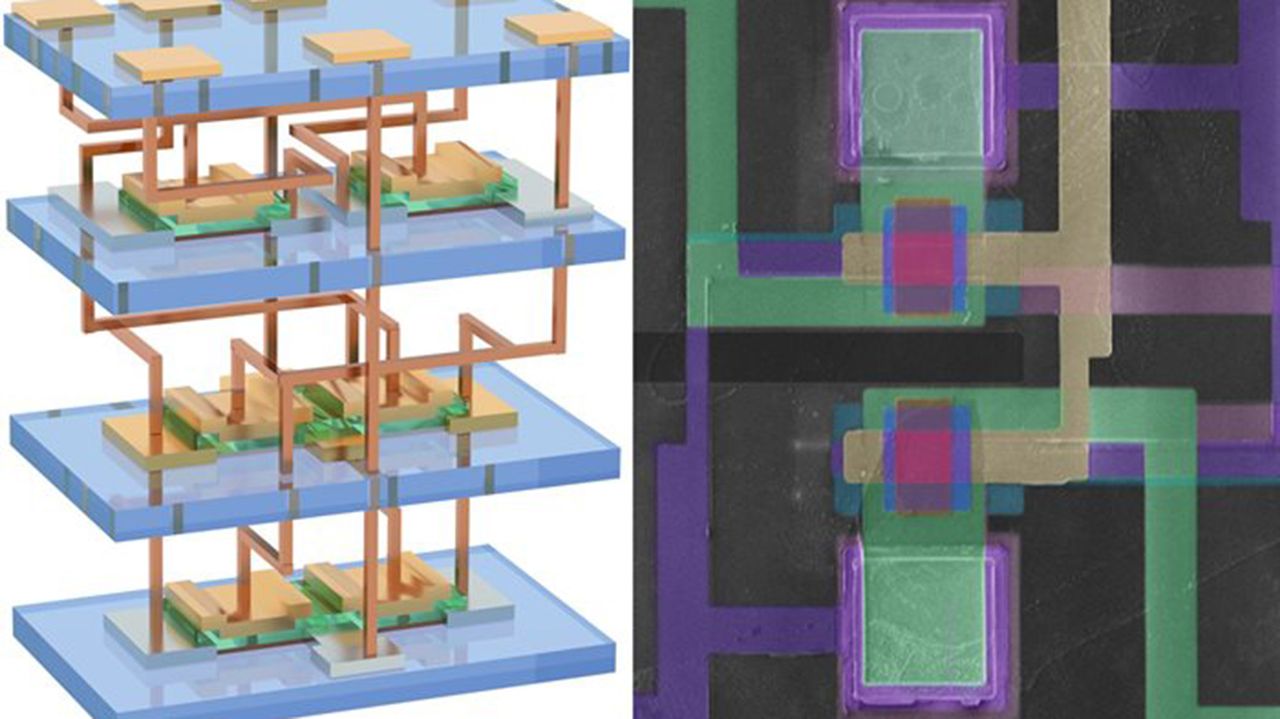
To get around this problem, the team structured the Guiyi 2D flash memory chip to feature a layer of graphene before the floating gate — a trap that can hold electrons and a place where data can be stored even after power is switched off.
Electrons can move through graphene's single-atom hexagonal lattice with very low resistance and at high speed with minimal energy loss. This layer of graphene enables electrons to accelerate before jumping into the floating gate, where they are then trapped.
The result was a stronger electrical pulse from a single trapped electron, which produced a 0.5-volt signal — 10 times stronger than previous single-electron attempts, the researchers said.
Liu told China Daily that Guiyi could help data move more quickly between computing and storage units. "That would significantly reduce data transfer delays, improve computing efficiency and help expand AI applications across industries," he said.
The challenge in scaling up
Guiyi is another example of "researchers exploring new device architectures to overcome today's memory bottlenecks" caused by artificial intelligence (AI), Andrew Humphris , a professor of nanoimaging at the University of Bristol and founder of semiconductor metrology company Infinitesima, told Live Science in an email.
Demand for AI workloads and large language models has created a performance gap between processor and memory speeds, thereby slowing data transfer. At the same time, the three chipmakers that dominate the NAND flash memory market — Samsung, SK hynix and Micron — are deprioritizing this form of non-volatile memory that keeps data stored when power is turned off.
Instead, they are increasing capacity for high-bandwidth memory. This has caused a NAND shortage and pushed up prices. Technologies like Guiyi, which promise to speed up data transfer, could fill the gap.
Although Guiyi is a strong proof of concept, commercial use will be a different story. Humphris warned that the real challenge will be in scaling up, saying, "a scientific breakthrough can only transform an industry when it can be produced reliably, repeatedly and economically."
Related stories
Scientists say they've eliminated a major AI bottleneck — now they can process calculations 'at the speed of light'
What's the biggest bottleneck to building better AI? It's no longer the lack of computing resources — it's generating enough energy to feed it
New memory chip controlled by light and magnets could one day make AI computing less power-hungry
He cited the example of component maker ASML, whose extreme ultraviolet (EUV) technology has become ubiquitous in the semiconductor industry; it's used by the likes of Intel and Samsung for the production of 3- and 5-nanometer process nodes. ASML took more than two decades to take EUV technology from the research lab to commercial production — which is much longer than the company had anticipated .
"The companies that shape the next generation of AI chips won't just be those with the best technologies," Humphris added, "but those that can manufacture at scale and at the right cost."
Nonetheless, the team led by study first author Zhou Peng , a microelectronics professor at Fudan University, has bold plans. As reported by the South China Morning Post, he told Jiefang Daily (the official daily newspaper of the Shanghai Municipal Committee of the Chinese Communist Party) in June that they plan to set up a company later this year to commercialize the technology within three to five years. If they're successful, he said, it could "shake up" the flash storage market.

Comments
No comments yet — be the first to weigh in 👇
No comments yet. Be the first!