Full text
Mercedes will test the safety credentials of ProLogium’s solid-state batteries.
The fourth-generation tech includes a non-flammable inorganic electrolyte.
ProLogium is planning a large solid-state battery plant in Dunkirk, France.
For more than a decade, Mercedes-Benz has worked with Taiwanese energy company ProLogium to help bring advanced solid-state battery technology to the auto industry. The two firms have now strengthened their partnership, meaning Mercedes will get priority access to test the firm’s fourth-generation cells, which could help to reshape the automotive industry.
var adpushup = window.adpushup = window.adpushup || {que:[]};
adpushup.que.push(function() {
if (adpushup.config.platform !== "DESKTOP"){
adpushup.triggerAd("0f7e3106-c4d6-4db4-8135-c508879a76f8");
} else {
adpushup.triggerAd("82503191-e1d1-435a-874f-9c78a2a54a2f");
}
});
Solid-state batteries have long been viewed as the holy grail of battery tech. By replacing the liquid electrolytes of traditional lithium-ion batteries with non-flammable solid materials, these batteries offer higher energy density, support faster charging, are safer, and last longer.
Read: Geely’s New Solid-State Battery Lasts 621,000 Miles And Starts Pilot Testing Next Year
Mercedes-Benz, much like BYD, Toyota, Nissan, Honda, VW, Stellantis , Chery, and others, is actively developing and testing these batteries for its next generation of EVs. Some may be ready to hit the market within the next 12 months.
var adpushup = window.adpushup = window.adpushup || {que:[]};
adpushup.que.push(function() {
if (adpushup.config.platform !== "DESKTOP"){
adpushup.triggerAd("89c65a14-4682-4807-a4bb-5436c5361bee");
} else{
adpushup.triggerAd("f25825bd-1260-4574-84ce-2b26e315fad8");
}
});
Through its deal with ProLogium, Mercedes-Benz will perform electrical, thermal, and safety testing on the company’s Gen4 lithium ceramic battery cells at its facilities and at third-party testing institutes. These batteries use ceramic separator technology and have a non-flammable inorganic electrolyte, which is said to enable not only fast charging but also high power output.
“At Mercedes-Benz, we are committed to shaping the future of electric mobility through technological leadership and innovation,” Mercedes-Benz Group AG member of the Board of Management, Jörg Burzer, said. “Our long-standing partnership with ProLogium is a strong example of how we bring the best expertise together to advance next-generation battery technologies. By combining ProLogium’s pioneering solid-state battery approach with Mercedes-Benz’s deep battery development, testing and integration capabilities, we are taking the next step in exploring advanced battery technologies for future electric vehicles.”
Solid-State Battery Production Is Coming To Europe
ProLogium already operates a large battery factory in Taiwan and is planning a site in Dunkirk, France, with a capacity of up to 44 GWh. It says this factory will allow it to provide cells to customers across the continent, including Mercedes.
The German brand has another important solid-state battery partner. In addition to working alongside ProLogium, Mercedes-Benz is also testing lithium-metal battery cells from American company Factorial Energy.
var adpushup = window.adpushup = window.adpushup || {que:[]};
adpushup.que.push(function() {
if (adpushup.config.platform !== "DESKTOP"){
adpushup.triggerAd("bb7964e9-07de-4b06-a83e-ead35079d53c");
} else {
adpushup.triggerAd("9b1169d9-7a89-4971-a77f-1397f7588751");
}
});
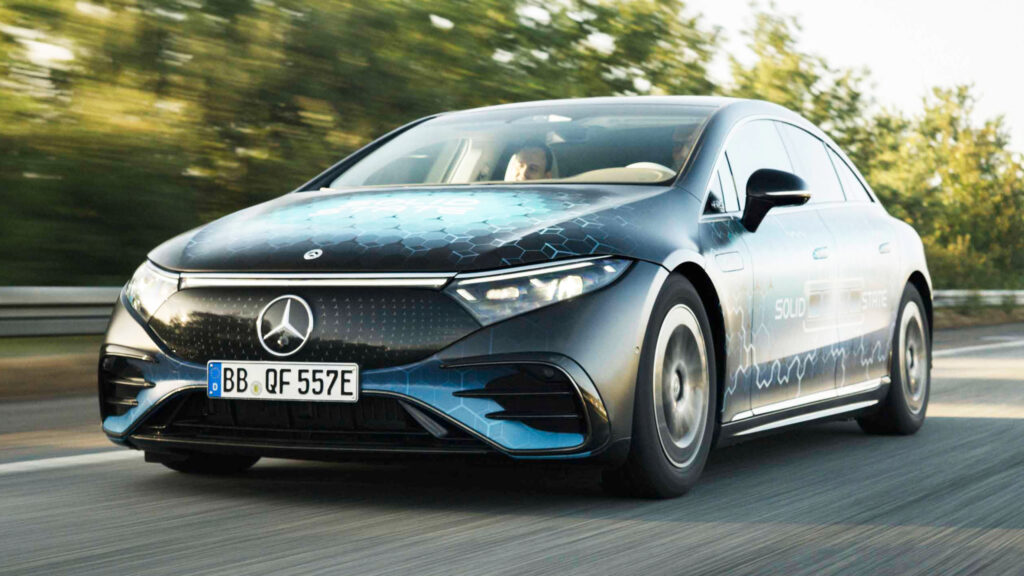
Last year, a Mercedes-Benz EQS equipped with one of Factorial’s solid-state battery packs was driven 748.8 miles (1,205 km) on a single charge. It could have been driven even further, as Mercedes says the EQS finished the test with an estimated range of 85 miles (137 km) left.
var adpushup = window.adpushup = window.adpushup || {que:[]};
adpushup.que.push(function() {
if (adpushup.config.platform !== "DESKTOP"){
adpushup.triggerAd("bb7964e9-07de-4b06-a83e-ead35079d53c");
} else {
adpushup.triggerAd("9b1169d9-7a89-4971-a77f-1397f7588751");
}
});


Comments
No comments yet — be the first to weigh in 👇
No comments yet. Be the first!