Full text
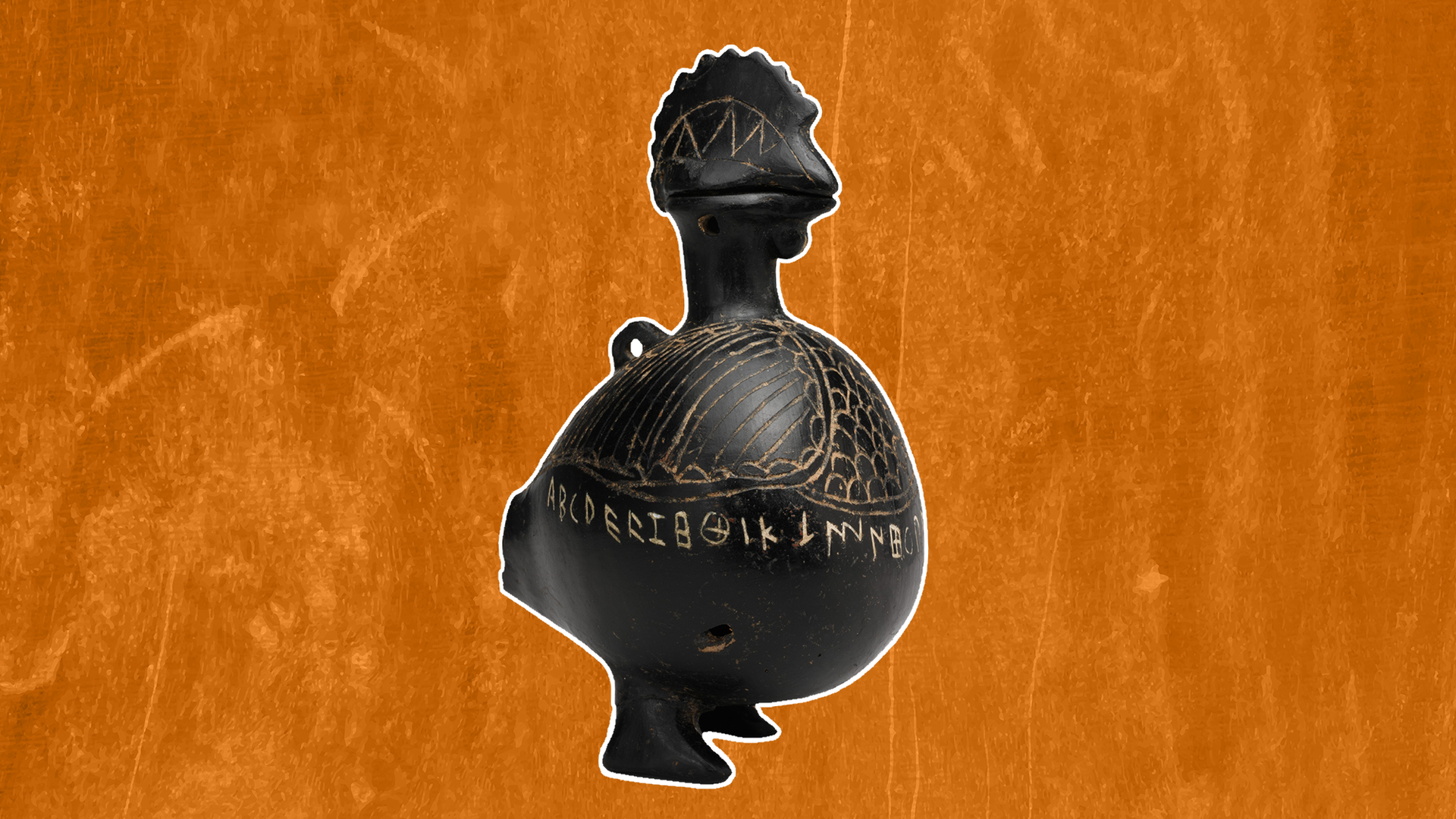
The chicken-shaped, black-glazed vase has an abecedarium — an inscription with the 26 letters of the Etruscan alphabet in order. (Image credit: Metropolitan Museum of Art; Fletcher Fund, 1924; Creative Commons Zero (CC0) ) QUICK FACTS
Name: Terracotta cockerel vase
What it is: A bird-shaped ceramic inkwell
Where it is from: Viterbo, Italy
When it was made: Circa 650 to 600 B.C.
This small terra-cotta vase, which is shaped like a cockerel or young male chicken with human feet, was discovered in central Italy and was made by the ancient Etruscans. The potter inscribed the Etruscan alphabet on the body of the chicken, giving modern researchers clues to a language that has never been fully deciphered.
The vase stands just over 4 inches (10 centimeters) tall and is in the collection of the Metropolitan Museum of Art in New York City. The dark-black ceramic, known as bucchero, was made through a unique firing method that prevented the kiln from getting enough oxygen, which caused the clay to absorb carbon. Bucchero is considered the trademark Etruscan ceramic, and it was produced from the seventh to the fourth centuries B.C. by this pre- Roman society. It is unclear where the cockerel vase was originally found, but it may have been discovered in a grave in one of the many cemeteries that surround Viterbo, which was originally an Etruscan town about 50 miles (80 kilometers) northwest of modern-day Rome.
According to The Met, the vase may have been a portable inkwell used by an ancient Etruscan who was learning how to write. The cockerel's head was the stopper, and it was loosely attached to the body by a cord through a set of loops. The inscription on the body of the vase is known as an abecedarium — the sequential list of letters in an alphabet.
The Etruscan alphabet is well known, since it was adopted from a regional version of the Greek alphabet in the early eighth century B.C. There were 26 letters in the Etruscan alphabet, but one of them in this abecedarium is incorrect. A close look at the end of the alphabet shows that someone inscribed an S twice; the second one should look more like an X, according to The Met .
The terracotta cockerel vase was one of several ancient Etruscan artifacts that helped experts partially decode the mysterious ancient language, as it preserved the order of the letters in the early alphabet, archaeologist Gisela Richter wrote in a 1930 catalog of The Met's classical artifacts.
Thanks to the adoption of the Greek alphabet, it's possible to fully sound out the Etruscan language . But although more than 10,000 Etruscan inscriptions have been found, the language is still only partially understood because those inscriptions are short and any lengthy Etruscan literature that once existed has been lost.
For more stunning archaeological discoveries, check out our Astonishing Artifacts archives.
Mold Gold Cape
Birdman Copper Plate
Inuit Carving of Norseman
Can you put together last week's Astonishing Artifact ?

Comments
No comments yet — be the first to weigh in 👇
No comments yet. Be the first!